Thursday, March 26, 2009

Driving- A Blog Within a Blog

Yesterday we were coming back from one of the villages, and Josafat asked me if I wanted to drive. The roads are pretty intense, windy, rutted, constant up and down, sheer drop off on one side most of the time. But I decided to give it a try. It takes a lot of focus, but actually wasn't so bad, and made me think of the first time I drove in Mexico 2 years ago. Here's an excerpt from my MySpace blog that I wrote in May of 2007 when I was living with Josa and his girlfriend in Puebla doing a teaching practicum:

"Tuesday was my only free day before starting my practicum, and we ended up taking a mini road trip to the small indigenous town of Cuetzalan. Josafat is a masters student in agricultural economics, specializing in rural development. He's currently working on his thesis analyzing and comparing the role of the Food and Agriculture Organization in 3 parts of the state of Puebla. Anyway, there was a meeting he needed to go to in Cuetzalan, a 4 hour drive for a half hour meeting. But it was important, and his girlfriend and I decided to join him. They both have cars, but Josa got a car from his school as his was too "fresa"- literally strawberry, but means rich, snobby, inaccessible- for the countryside.

We were off by 6am in our old blue VW bug- called vochos here- with no radio, ac, or seat belts. Josa and Kari were dead tired from haciendo fiesta the night before, and I wanted to help with the driving. I am terrified of driving in road-anarchic Mexico, and only last month was I comfortable driving stick (called "estandard" here) in Seattle. Pero bueno. I was doing well except for all the topes- speed bumps, a little taller than ours and maybe 3 times as wide. They are everywhere; you´ll be cruising at 40 mph and suddenly a tope. As I was getting those down, we stopped for a delicious breakfast of squash blossom quesadillas and fresh squeezed orange juice.

We only had a hand-drawn map and road signs can be few and inconsistent. As the highway gave way to windy mountain roads, gravel, steep drop offs, it started to feel as if the location of this town was a secret. We got closer only by continually asking in every town if we were going the right way. One time we pulled into a town with a sign for Cuetzalan pointing straight ahead, but then you could only turn left or right! The roads are extremely bumpy and you're always dodging potholes. On top of other driving challenges, we were getting into a cloud forest and visibility wasn´t great. Also, you have to watch for road blocks in the form of señoras and young girls hanging up a rope and stopping you for donations to their saint of the day.

We finally arrived, descending sharply into this stone town. It immediately struck me as what Venice might be like were its narrow, elusive waterways filled with smooth stones and then the whole city stuck steeply and resolutely to the side of a mountain. The roads were so steep you couldn't really see the declivity until you started going down it. "Straight ahead?" I asked Josa. "Si, derecho," he answered, and I started going straight down the hill until we saw that it wasn't really a hill but turned into stairs! We had to back up, but putting the bug in reverse going down hill with the threat of driving down stairs was beyond my driving skills for the day. Josa pulled the emergency brake so we could switch places… and the hand brake pulled right off. "Tenemos un problema grande," he said astutely. There were two good wheel stones right by us- leaving me to believe that we weren't the first ones to drive down that street- so we put them under the tires, pulled what was left of the e-brake, and quickly switched spots. But the grace of the saint of the day, Josa backed up, and we made a note to park on flat ground for the rest of the day."

Wednesday, March 25, 2009

Leaving the Coast


After the coast I headed inland to meet up with my friend Josafat. We went north of Mexico City to Pachuca where his girlfriend was having her big birthday fiesta at her parents' house. There was alcoholic horchata, artisenal mezcal, a keg of beer, chicken chalupas, jicama chile salad, fresh strawberries and cream, hoards of old friends... and a karoake machine! Party guests sang for hours and hours, from Mexican pop music to American rock to traditional norteño. I personally rocked some Shakira, Juanes, Beatles, and Nirvana.

In the morning the party continued and 2 carloads of us drove up into the hills to the small, quaint village of Real del Monte. It is actually considered one of the 12 "magical villages" of Mexico, along with Real de Catorce, San Miguel de Allende, Tepoztlan, Cuetzalan, and I don't know where else. But it definitely has an colonial, frozen-in-time feel, the way that inland Mexico is often depicted in movies. Right by there is El Chico National Park, the first preservation land in all of Latin America. There are cedars and pines along with bromeliads hanging from the trees.

Once the weekend of fun was over, it was time to get to work. Josa and I took an overnight bus south to Tlapa de Comonfort, Guerrero, the small city where his office is based out of. The city was recently militarized due to drug-trafficking, and uniformed men with huge guns abound, which kind of freaked me out of at first. But now I go jogging in the mornings and run past them without thinking about it too much.

Josafat works for a government-funded food security program called PESA (Proyecto Estrategico de Seguridad Alimentaria). With 17 development engineers, they work in about 65 indigenous communities throughout the state. He is one of the coordinators of these engineers, and oversees their projects.

There are 3 different ethnic groups in this region (Nahua, Mixteco, and Tlapaneco) and their villages are anywhere from a half hour to a 6 hour drive from Tlapa de Comonfort. Within the scope of their program, they are only reaching about 10% of the indigenous population in the state, which is one of the poorest in the country.

The PESA employees do educational workshops in the villages, and then do a participatory demonstration project with a resident so others can learn how it's done. Then an engineer is there to help anyone else do their own project. This year they have focused on building wood-efficient cookstoves (as opposed to cooking over an open fire), chicken/turkey coops, composting-toilet bathrooms, ferrocement water storage tanks, and home gardens.

On an average day, we leave town at 7am and drive a couple hours with the 5 other members of Josafat's team in the cab of his pickup. It's cramped, but these are all jolly co-workers, a couple of whom speak Nahautl or Mixteco. These are hot, dusty, windy mountain roads. It is about a month until the rainy season begins, so right now is the driest part of the year. We finally get to one of the communities, and the town announces our arrival over a loudspeaker so that everyone knows it's time for a meeting.
Señoras slowly start making their way toward the meeting hall, most carrying a baby on back or with small kids trailing behind. In all 3 local languages, nana means señora or ma'am. This is a Mixteco village, so we shake all their hands and greet them with a hello, Kwa u nana! It is only women who are involved in the project; since they do all the cooking, they have the most relation with the question of food security. Plus, men and women's work does not frequently mix here, so it is all women and children, maybe 70 in all, who arrive for the meeting. As the program is winding down for the year, now is the time for closing workshops, to evaluate what worked and what could be improved.

As these communities, and individual people, are receiving government money, the program has to maintain good paperwork to prove that the money is being used for its right purpose. So every person who has received money has to sign their name on a form, and this takes the first hour. As a lot of them cannot write, they put their fingerprint. They break into groups to discuss the various projects that they have done, as well as to talk about the upcoming environmental conservation efforts that will start next.

I help Josafat do some very basic environmental education, talking about the effects of mass deforestation on the hillsides, erosion, use of chemical fertilizers in their fields, and the bio-accumulation of contaminants. It's hard to tell how much is being understood without a Mixteco interpretor, as a lot of the community members speak limited Spanish. Josafat says they understand more than they speak, because indeed they are shy of outsiders. More than once a child saw us and burst into tears, reacting to the unfamiliarity of Josafat being a fairly light-skinned Meztizo and to me being a guerra.
One great thing about the program is that they only do projects with people who want them, and they provide materials and technical help, but the community has to do most of the work themselves. That way, they learn new skills and are invested in the results. Much of the Mexican government's assistance to the poorest population have been in the form of handouts, just giving money or materials without any follow-through on how it is used. In almost every community I saw piles of unused building materials, such as wood shingles or rebar or bags of cement or wheelbarrows- provided on some other occasion without a community liason, education, training, or follow-up.

The majority of men who would know what to do with these materials are outside the community, either migrated to work in northern Mexico or the U.S. PESA is non-partisan and seeks to create more long-term solutions for healthy, self-sufficient, and sustainable food systems.

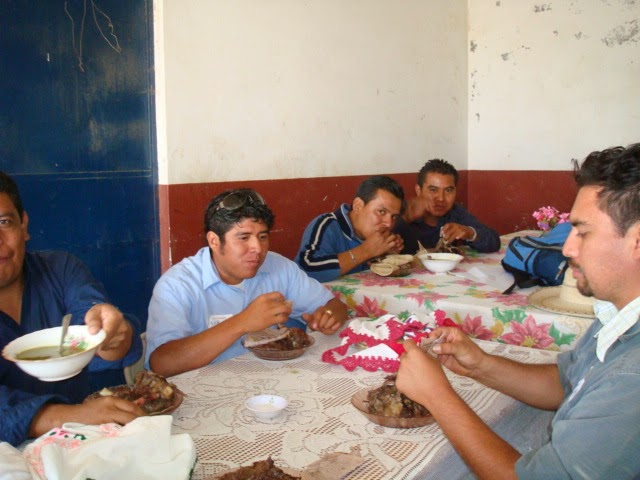
The community members always offer to feed these rural technicians who have traveled a long way. One day it was chicken in a red mole, with hot tortillas off the comal as the señora made them. No utensils, just tortillas as an eating medium. Oh, and a big soda. As Josafat says, there are many villages without a doctor, but you won't find anywhere without Coca-Cola.

In another community they roasted a sheep as a thankyou for the end of the season. It was a generous, though somewhat gristly meal, served along with green salsa, blue corn tortillas, and the sheep's liver, which I politely declined.
We are almost home around 8pm, and it's been a long 13 hour day. I want nothing more than to take a shower, drink some water, and go to sleep. But no, in one of the closer villages to Tlapa, another place the program works, we stop for beers. I try to refuse, and everyone is puzzled- why would you turn down drinking a cold beer with friends?

"Just don't say that the people of Guerrero didn't try to show you a good time," Josafat's coworkers tell me. Finally after a few rounds, and me translating some Alan Jackson song lyrics for them, we get back to the office in Tlapa... where someone suggests more beer! You have got to be kidding. We are meeting back at the office at 6:45 a.m., and I have a feeling that I'm going to get a little behind on my running schedule this week.

Vamos a Mexico!


I didn't realize just how familiar Mexico would feel when I stepped off the plane in Puerto Vallarta. I felt almost gleeful at the pushy taxi drivers, the call for coconuts by a man pushing a cart down the street, the smell of tacos al pastor, the unmarked bus stop, the boys walking by saying a few words in English to demonstrate their knowledge. I hopped a bus to the coastal town of Sayulita, north of PV, where a friend lives and a couple other friends were visiting. We went surfing, sunbathed, swam, napped, watched schools of fish play in the waves, ate chilaquiles, fish tacos, and tropical fruit with lime, salt, and chile. Wow, I forgot how much I love the food here. All the fresh bright flavors, spice, deep smokey salsas. My gastronomical experience in South America was so incredibly bland by comparison.


I also babysat my friend's 2 year old bilingual daughter. She is so cute. We watched Curious George in Spanish together, and read a lot of books. Another highlight was going out to open mike night, a mix of Mexican and foreign musicians, mostly all residents. At one point someone played "Under the Bridge" by Red Hot Chile Peppers. The audience sang along, they knew the words, and I could hear all around me people singing with French, British, or Mexican accents. Then I went swimming with new French friends, phosporescence glowing bright in the warm, dark water.

Wednesday, March 4, 2009

Daytona Bike Week


This week I had the chance to see into the American sub-culture of bikers! My dad took me to bike week in Daytona Beach. Unlike the people who trailer their bikes to the event, my dad and I were hardcore and rode across the state, making the journey part of the experience. It had been hot the week before, then got cold the day we left on the motorcycle, so it was an intense ride, giving me more respect for cyclists and bikers who are more exposed to the elements when traveling. The wind was blowing, the sun was in hiding, and even in leather chaps the air was cold. But we had a fun, and took a couple days to visit relatives and enjoy the Atlantic side of the state.


Friday, February 27, 2009

A Visit to Florida

It's so nice to escape the dreary northwest winter (God bless it) and within a few hours be in the swirly humidity of Florida. Not only is it hot, but I'm reminded that not all life is dormant in the winter. Osprey are nesting on tall pillars. Gopher turtles scurry into sandy holes. Spanish moss drapes from tall cypress. Oranges are hanging heavy on the trees if they haven't already been harvested. Strawberries are in season and local festivals are happening.

Oh yeah, and I have also been vacationing in a nudist resort. There are no juicy details to share, just regular people who like to kick it in their birthday suit- year round. I think the fact that these folks live in a resort is more striking than the fact that it's a nudist community. The residents here are some families and mostly retired people. Actually, only married couples were allowed here until about 25 years ago, to promote a mellow, family-oriented vibe.

They are bonded by the fact that they like to have the freedom to be naked- which doesn't mean they always are, just that the option is there. Actually, with being so acclimated to the Florida weather, most resident nudists are wearing clothes if it's below 72, and inside with air conditioning if it's above 90. The resort draws all different kinds of folks, from a former head of the NYSE with his shiny kajillion dollar RV and hummer, to people who want to commune with nature and pitch a tent at one of the rustic campsites. What I really like about the lifestyle it is that it promotes an awareness of your own body in a healthful and non-judgemental way. No one has a perfect body, and since no one is hiding it, then no one is self-conscious, and you reach a totally new level of comfort.

Also, since the weather is so nice most of the time (there are more nudists per capita in the county north of Tampa than anywhere else in the country) most people spend a lot of time being active outside. These are the fitest retirees I've ever met. The other day I got a tennis lesson from a 71 year-old in amazing shape. He pointed out a man on the court next to us playing doubles, who was 85 (and looked 60). "That man has 14 YEARS on me, and look at him!" my instructor exclaimed. "Keeping active is the way to stay young."

So I've been enjoying the facilities, swimming daily, running in the woods, learning petanque (French-Canadian version of Bocci Ball), sunbathing, watching volleyball matches, and in the evening when it gets chilly in the 60's, taking a soak in the hot tub.

I wish I had some photos to post, but taking pictures here is strictly prohibited. For obvious reasons.

Monday, February 16, 2009

Happy V.D.


For the 5th year, I took part in the madness that is Valentine's Day at a flower shop. It was a great excuse to come to Bellingham and see old friends and co-workers, and get lost in piles of sweet-smells for a few days. Despite the long hours, we have a blast in our warehouse of creativity.

You talk to lots of people and hear about their lives, which is part of why flower shops are an important part of community. You might make bouquets for a man sending flowers to his wife of 40 years, or a husband in Iraq to his new bride, or a sister to her sister, or a dad getting a small bouquet for a young daughter. My favorite story though was from an older man who hobbled into the shop, eyes watery. He wanted to get a plant for his neighbor woman across the street. He explained that her husband had drowned a couple years ago while they were on vacation in Hawaii, and she was 6 months pregnant with their first child. His wife of 50-some years had also recently passed away. While the neighbors hardly knew each other at the time, they ended up bonding over their similar losses, and as he was also a pediatrician, he could answer her questions about the new baby. Now they have dinner together every Saturday night. He reminded me of how close love is to loss, and that sometimes the best relationships are unconventional.

The old man leaned in close to tell me, "And we're just good friends, there's nothing, you know, romantic going on." Well, I had assumed as much based on the age difference, but I thought it sweet that he made a point to clarify. I assured him that a plant was an appropriate "friendship" valentine gift, and the man wiped his eyes and left the shop smiling.

Tuesday, February 10, 2009

Winter Vacation


I've decided to take a break from the island for the rest of the winter- to work in Bellingham, see family, and do some traveling. I'm looking forward to a change of scenery, and just as much looking forward to returning to the yurt in the spring. I had a lovely last day here- horseback riding followed by a farewell dinner. It was a mostly outdoor meal, undetered by rain on a cozy porch, around a grill and fire. There were oysters with tomato-wine piquat sauce, mashed potatoes with summer's pesto, root veggies, grilled blackcod, steamed chard, and homemade chai with milk milked hours before from a local cow. It was a wonderful feast.

Here are a few more recent photos from this winter...


Friday, February 6, 2009

Doing my Reluctant Part to Pollute

Not to toot my own horn, but I live a lifestyle of pretty light environmental impact. I haven't owned a car for 5 years, instead cycling, walking, mass transiting, or sailing to get around. I lived off the grid for half of last year, only using minimal light generated by a solar panel. I eat almost entirely locally during our growing season, including produce, honey, and meat from Orcas. As much as I love Spanish wines and Argentine malbecs, I make a point to buy Washington wines and even San Juan vineyard or Lopez ones regularly. I compost, buy used clothes, and always bring my own grocery bag and coffee mug.

As hard as I try to minimize my consumption of fossil fuels, I bought a car today! It feels like a regressive step in a way, but a big move forward in others. I'm pretty excited to not have to ask for rides, bicycle in the pouring rain, hitch-hike in the dark, or take city buses loaded down with bags. It's a maroon '85 Toyota Camry, and looks pretty much like this one. It's a 5-speed that should get good mileage, and I bought it from the original owner who took great care of it.


Oh, and I've vowed to keep my front seat clean so I'm always ready to pick up hitch-hikers and start repaying the transportation gods for all the times I got great rides.

Thursday, February 5, 2009

Mental musical exercise


I'm learning an instrument for the first time in my life! It's the baritone ukulele, and it totally rocks. Forget your assumptions about how ukuleles sound- the baritone is different, more like a small, 4-stringed guitar. I love to sing, and it is so satisfying to be able to accompany myself now. Having such small hands, I always struggled with the guitar, but the moment I picked up the baritone uke, it just felt natural. It feels accessible, and yet I have to remember that learning a new instrument takes time, and even simple chord changes challenge my brain more than it seems like they should. I'm stoked and I can't thank Jon Manning enough for introducing it to me over bubble tea.

Tuesday, January 20, 2009

(Out with the old) In with the New!


"Now, there are some who question the scale of our ambitions — who suggest that our system cannot tolerate too many big plans. Their memories are short. For they have forgotten what this country has already done; what free men and women can achieve when imagination is joined to common purpose, and necessity to courage."

I've been waiting excitedly for this day since the election 2 and a half months ago. I even considered going to DC for the inauguration, but decided against the cold, crowds, and chaos. In the end I stayed on Orcas to bask in the day, and listened to Obama's speech online while at work.

"On this day, we come to proclaim an end to the petty grievances and false promises, the recriminations and worn out dogmas, that for far too long have strangled our politics. On this day, we gather because we have chosen hope over fear, unity of purpose over conflict and discord."

Then my friend brought me champagne and orange juice at work for celebration mimosas(drank later off the clock). In the evening we went to a community party with families, good food, and a life-size Obama cutout.

A few of my favorite lines from the speech-

"Rather, it has been the risk-takers, the doers, the makers of things — some celebrated but more often men and women obscure in their labor, who have carried us up the long, rugged path towards prosperity and freedom."

"We will restore science to its rightful place, and wield technology's wonders to raise health care's quality and lower its cost. We will harness the sun and the winds and the soil to fuel our cars and run our factories. And we will transform our schools and colleges and universities to meet the demands of a new age. All this we can do. All this we will do."


If you want to read the full text of Obama's inauguration speech, it's at
http://www.nytimes.com/2009/01/20/us/politics/20text-obama.html