Sunday, March 15, 2015

An Early Spring in Western Washington

It's been an incredibly dry and warm winter, and I kept expecting winter to actually hit. I made a valiant effort at being wintery, and made sure to eat lots of waffles, cheese, and cookies.
My friend from Texas actually has a
Texas waffle iron
My roommate turned 30 and had a birthday
party with 30 different kinds of cheese
A roommate was on a low-carb diet, and
proceeded to bake lots of cookies and
muffins and ask us to eat them.
I also went on a Marsala kick. What's more wintery than cooking with wine? I made Chicken Marsala, Marsala-poached pears with vanilla ice cream, and a mushroom Marsala pasta bake.

Try as I may, winter never actually came. It's been consistently mild with barely any snow in the mountains. Local meteorologist Cliff Mass called it The Winter Without Seasonal Affective Disorder. Maybe I'm ungrateful, or a glutton for punishment, or just a true Pacific Northwesterner, but I don't feel like I've earned spring yet.

But nature didn't take my sentiments into account, and it's actually been acting like spring since about mid-January. Rhododendrons were already in bloom, and many other flowers followed.
 
A few weeks ago I rode my bike along the waterfront in downtown Seattle toward Magnolia, and over the Ballard Locks. It felt like summer with all the people out and about, and all the boats going through the Locks. Check out these pictures from our Golden Gardens picnic-- you would never know this was February.
 Now that it is really almost spring, I'm pretty excited to start getting outside more. What are you looking forward to this spring?


Thursday, February 26, 2015

Notes on Editing

Last fall I started a certificate in editing at the UW. I've always been interested in editing, and have been a de facto editor for friends and family on everything from websites to resumes to grad school and medical residency application statements.

But working closely with editors as a writer over the past year has cemented my appreciation for editors, and knowing how much I like working with them solidified my wanting to be one.
In copy editing class, we got to learn old-school
editing marks. (This image from here.)
I told a friend that I was taking the certificate program and he said, "Oh cool, so you'll be pretty much catching typos?"

Well, that is of course one part of an editor's job, but just a tiny part. And even little typos can have devastating, expensive consequences. Check out this hilarious article on 10 Very Costly Typos.

There is a lot I want to say about the course and how much I've learned. For now though, there is one thing that stands out to me when it comes to the importance of copyediting: maintaining consistency in a document.

Often there is not one right or wrong way to do something, but rather a conscious choice decision based on designated resources, writer preference, editor decision, house style, or some combination thereof. It's about knowing what to ask up front, and then sticking to the answer. It is deliciously ordered and tidy. I am by no means a neat freak or perfectionist, but that part of me does feel very content in this kind of work. Editing is sort of like getting a really good haircut.

But why does consistency even matter? I'll let an excerpt from a class reading say it better than I could:

If misspellings occur in a book, many readers will be taken aback and are apt to lose faith in the author, even though what he has to say may be brilliant. Incorrect facts, wrongly attributed quotes, and garbled sentences have the same effect.

More obliquely, few readers will notice occasional stylistic inconsistencies: "ax" on page 12, "axe" on page 34; "traveled" on page 17, "travelled" on page 92; "thirty-three sheep" on page 21, "33 people" on page 99. But the sum total of such inconsistencies will give readers an uneasy feeling that something is wrong. They may not be able to pinpoint the irritants, but they are likely to become subconsciously upset- and may lose interest in the book.

(Passage from The Complete Guide to Editorial Freelancing, rev. ed., Carol L. O'Neill and Avima Ruder (Barnes and Noble Books, 1979)

Doesn't that just blow your mind?

Saturday, January 31, 2015

10 Years Since Mexico

It was January of 2005 that I went to Mexico for the first time. I did a study abroad on US-Mexico Relations and Labor Migration, and then traveled for a couple more months researching Mayan ruins and volunteering on organic farms.

It was a transformative 5 months, and I met wonderful friends that I am still close to today. Although I wouldn't start this blog until a couple years later, that trip to Mexico was truly the beginning of "AmberAnda." It was me, my desire to speak Spanish and travel, and a burgeoning love for Latin America.

I also met Josafat. We dated for a few months, but for the last 9.5 years have had a dear friendship. It feels especially full-circle to think back to that journey when I met him a decade ago, because he is getting married this April and I am lucky enough to get to go to his wedding.
Josa and I, Texcoco, Mexico, 2005
Since this blog didn't exist back then, I've never posted photos from that journey. So to mark the 10 years, here's a look back.

I don't know how I got the idea to travel the whole length of Mexico overland, but that's what I did. I flew to San Diego, bused to Tijuana, then all the way down Baja California. I volunteered on my first WWOOF farm near La Paz. On a day off, we hiked up a river valley and soaked in unmarked hot springs.
Next I caught an overnight ferry across the Sea of Cortez to mainland Mexico, and headed to Sayulita to visit a friend from home whose family has a place there.
My amiga teaches me how to surf in Sayulita
Then I headed to the lovely colonial city of Morelia, in the state of Michoacán, to start school at the Universidad Latina de America.
Cathedral of Morelia
The study abroad was run through the University of Oregon, but the students were from all over the U.S., and they were awesome. I met my favorite professor I've ever had, a professor or labor and economics from the U of O. Little did I know that I would later visit him and his wife in Eugene, then again when he was on sabbatical in NYC, and that we'd meet for drinks several times when he was visiting Seattle years later.
The study abroad crew
In addition to the great classes, the program took us on some fantastic day trips and weekend trips around Michoacán and beyond. 
Carnival in a small town outside Morelia. It was a flour
and shaving cream fight all over the street.
The annual Monarch butterfly migration happens in Michoacán
Ruins of Teotihuacan outside Mexico City
Taking in a Diego Rivera mural in Mexico City
Ruins from the eruption of volcano Paricutin. This is maybe
one of my favorite places I've ever been. Lava covered the
 entire town except the altar and steeples of the cathedral
I also met Josafat while I was in school. He didn't live in Morelia, but he was there one weekend on a work trip from Texcoco (near Mexico City) about 4 hours away. It's a wonder we ever met at all. How did it happen, you ask? Well, I saw him on a city bus one Friday evening in downtown Morelia, and we kept looking at each other. I thought he was so cute that I got off the bus at the stop after him and followed him into a bar.

We struck up conversation and the rest was history. I will never forget our first conversation. He was finishing his 4-year degree in agronomy, a word I had never heard in English or Spanish. He was already working as an agronomist on rural food security issues. Basically, he was doing the type of work that I had always wanted to do.

He also told me the story of the legends behind 2 of central Mexico's big volcanoes: Popocatépetl (17,800 feet) and Iztaccíhuatl (17,100 feet). Popo means "smoking mountain" and keeps watch over his lover Izta who is the "sleeping woman". I also had no way to know at that time that 2 years later I would be back in Mexico teaching English and seeing Popocatepetl from my house everyday, with it's plume of smoke rising into the sky.

Josafat came back to Morelia for a couple weekends and was always willing to hang out with us big group of foreigners.
Josafat hangs with the study abroad crew in Morelia

After the quarter of school was over, I headed to the magical and new-agey town of Tepoztlan, and spent a week on another farm/homestead.
Part of the yard on the WWOOF farm, central Mexico
Making handmade paper with an Irish volunteer
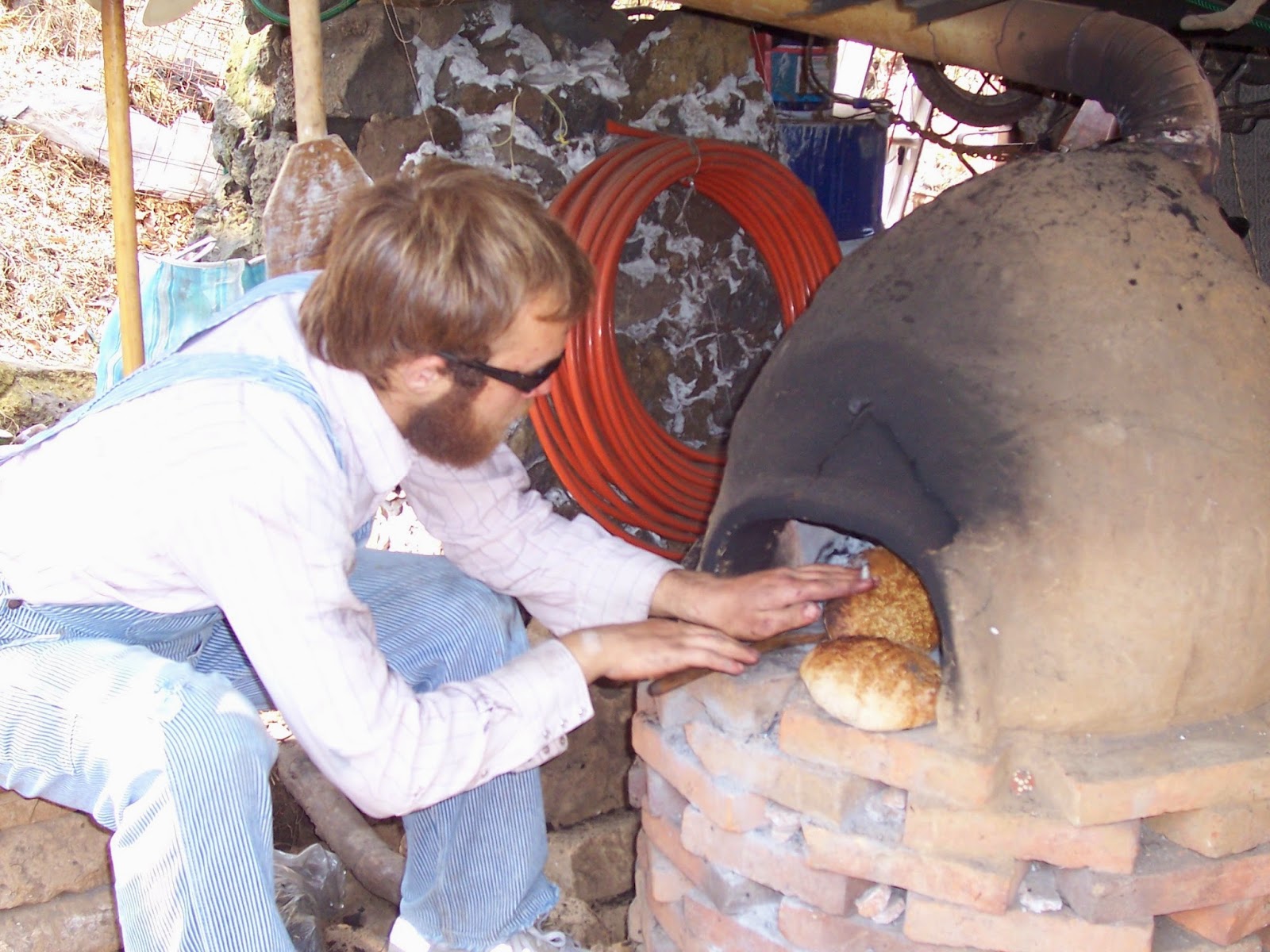
Baking bread in the cob oven
I happened to be on the farm on my birthday, and spent the day pouring concrete for a fence post for my first time. By the time we went inside and cleaned up to make dinner, the farmer realized that we didn't have all the ingredients to make a cake.

"But," he said, "I do have cacao beans if you want me to teach you how to make chocolate from scratch!" So after dinner, with music playing and plenty of red wine, we set to work making chocolate. And then I put my hair in a ponytail and cut it off.
Hand-grinding the cacao beans
Finished product: birthday chocolate!

After that, Josafat and I met up again and headed to Oaxaca for a week together. We went to Oaxaca City where every time he asked me what I wanted to eat, I said hopefully, "mole?" While I also love the dark mole poblano, I simply couldn't get enough of the yellow and green moles of the south.
Bussing south-bound
Ruins of Monte Alban
Mazunte, coast of Oaxaca
After a visit to the coast, Josafat went back to work and I continued traveling on my own. Next stop was Chiapas, and the start of my study of Mayan ruins. I was still enrolled in college half-time, and getting independent study credit to make an art travel journal of ruins, including a watercolor rendering of each one I visited.
Palenque, Chiapas
Painting at the ruins of Uxmal, Yucatan
El Castillo at Chichen Itza
Caribbean from the ruins of Tulum
Tulum is on the coast of the Yucatan, very close to the border with Belize. At that point, I had bussed from San Diego all the way south through Mexico. I continued into Belize and Guatemala, but that's a whole other story!

I flew back to Mexico City from Guatemala City and had a last weekend to spend with Josafat, who was now working temporarily from Guadalajara. I explored the city, hung with him at his office, and took a day trip to do some tequila tasting in the tequila region.

Here's to another decade of good friends, new travels, and transformative experiences.

Wednesday, December 31, 2014

Highlights of 2014

I've always thought the idea of designating a whole year as good or bad was silly. Surely too much happens in one year to make such a blanket statement.

But I can say without hesitation that 2014 was pretty phenomenal, and I am closing out December with a ton of gratitude.

In the spirit of "best of" lists, here's a look back at some of the highlights of the year.

First and foremost was starting a job in January that I absolutely love, at a company I have a lot of respect and appreciation for, with the best bosses I've ever worked with. When I was a teenager, I dreamed of becoming a professional writer but didn't think it was actually possible.
View from the observation deck of our office building. Once my manager and I had our one-on-one here. Best meeting ever.

Hanging out (intentionally) inside a crevasse

Catching crab from a canoe off Golden Gardens

Hanging out with sweet nieces and nephews
Climbing Mount Rainier and doing a headstand on the summit with crampons on
 
Catching a swarm of bees by myself
 
Spending time with my dad in Florida
 
Day hiking 18 miles in the Enchantments
 
Volunteering with the Beacon Food Forest and watching it produce food for the community

Seeing dear friends get married.
Backpacking by myself for a week in the Cascades

Volunteering at City Fruit's 4th annual Cider Taste, featuring multiple ciders from 10 of Washington state's artisan cideries
I am an ambassador for City Fruit, which is an awesome nonprofit that harvests excess fruit from trees around Seattle to donate to food banks. In November, I wrote Why I Donate my Time to City Fruit for their blog about the beginnings of my interest in agriculture and food justice.

Apart from all of those things, I'm hugely grateful for good friends. For the friends who are always there to talk; who make me laugh; who remember my nut allergy; who still send me mixed CDs; who will hike with me any time of year; who give me candles homemade with their own beeswax; who are up for impromptu pasta-making and bourbon-drinking; and who have given me rides in my carless year or let me borrow their car.

In 2015, I want to be as good of a friend to those people as they have been to me. I want to keep trying new things and saying yes, even when I don't know where it will lead me. I want to play outside even more, and read even more books, though I'm not sure how that balance will shake out.

I want to be the opposite of jaded, and full of hope for things to come. Happy New Year friends!

Friday, November 28, 2014

Thankful for Fledging

In January of this year I started a brand new job in a new field. I have always loved writing, but I had never done it professionally. Suddenly, for the first time in my life, I was working in an office, writing full-time, and doing projects I had never done before.

In my 20's there were so many things I wanted to do, but was deterred from starting because I felt like it was too late or I wouldn't be naturally good. Back in college I had a gym membership at the YMCA, and it had a climbing wall. I had always wanted to try climbing, but at 20 years old I remember sighing to myself and thinking, "everyone else probably has been climbing since high school, so there is no point starting now when I'd be so behind."

I don't know exactly how my mind-set shifted, but throughout my 20's, it did. I think it takes time to come into ourselves and not feel embarrassed to be new at something. I think we also have to give up needing to be the best, or even good at something in order to justify doing it.

Basically, what I was getting at was the importance of a growth mind-set, which I didn't quite have the language to describe until now. In my work book club we just read The Confidence Code, and one part really stood out to me. The authors write, "The starting point for risk, failure, perseverance, and, ultimately, confidence, is a way of thinking, one brilliantly defined by Stanford psychology professor Carol Dweck as a 'growth mind-set'.

The key to creating a growth mind-set is to start small. Think about what you praise in yourself or your kids. If you praise ability by saying, "You're so smart" or "You're so good at tennis; you're a natural athlete," you are instilling a fixed mind-set. If, however, you say, "You've worked so hard at tennis, especially your backhand," you are encouraging a growth mind-set.

Making a distinction between talent and effort is critical. If we believe that somehow we're given talents at birth that we can't control, then we're unlikely to believe we can really improve on areas in which we're weak. But when success is measured by effort and improvement, then it becomes something we can control, something we can choose to improve upon. It encourages mastery.

I was at the perfect point in my life to start a new career path and not feel intimidated or overwhelmed by it. I remember going to the final interview, in a downtown skyscraper, with a panel of six interviewers, and just feeling very matter-of-fact.

One interviewer asked me a question about how I would fit into the business culture never having done it before. I invoked my experience of traveling in 28 different countries and that I was no stranger to immersing myself in unfamiliar cultures.

I also said I was good at observing others and not making any sudden moves. "Don't worry, I wouldn't go into a client meeting wearing a mumu and drinking a margarita!" They laughed. "Then again, you guys offered me a beer when I got here today, so maybe BYOMargarita would be normal!" More laughs. As nerve-wracking as the interview was, it was also fun. I committed to being sincerely myself, but without taking myself too seriously or being apologetic of what I didn't know.

This year I have thought of myself as a fledgling writer, and my team has been very nurturing and protective of me taking baby steps in my position in a supported, gradual way. I accepted that I had a lot to learn, and in return, I never felt pushed out of the nest before I was ready. I had time to let my writing feathers grow in a little thicker, a little stronger.
Nest I found, Orcas Island, 2009
I've been able to embrace being a fledgling in other areas this year besides writing. I took a Basic Climbing and Mountaineering class, and learned a ton of new skills. Turns out, learning to climb a decade after feeling deterred is still not "too late." Even a fledgling climber can do exciting alpine climbs, and a fledgling mountaineer can summit Mount Rainier.

Recently I was out on Orcas Island and ran into an acquaintance who lives out there. He asked what I was doing in Seattle these days, and I told him tech marketing writing. "Wow," he said with a laugh. "Sounds really boring!"

For me, it couldn't be more opposite from boring. It provides more learning, challenge, growth, community, appreciation, and stimulation than I've had at any other job. I absolutely love it, and I'm so happy that the fear of not being the best marketing writer didn't stop me from applying. Being a newbie has hands-down been one of the best parts of 2014, and I highly recommend it.

Sunday, November 2, 2014

Filling the Cracks with Gold

Part of the fall harvest at the Beacon Food Forest
It was an especially hot and dry summer in Seattle--in fact, the warmest one on record according to Cliff Mass's A Summer for the Record books. I'm thankful I was able to spend a lot time outside and in the mountains. I think that's partly why I'm so resistant to going back to a more indoor existence now. And I know the fall rains are to be expected, and that in fact, Seattleites often Crave the End of Summer.

But there is a certain heaviness that starts to settle in as the days get shorter, a stark contrast to how light summer feels. And it can seem like intense events start happening all at once.
Downtown sunset
I heard a shooting for my first time, while at work in downtown Seattle. It was five shots, very close by. From our fourth floor vantage point, we could see straight down onto the scene across the street, where a man had been shot.

My coworkers and I watched, stunned, as the scene unfolded: the cops arriving and pushing away the crowd, taping off the area, taking witness reports, the firetruck and ambulance arriving, the paramedics attending to the man, then taking him away on a stretcher. Sadly, the young man died of his injuries later that day. We also found out that one of the bullets had hit our building, just 2 floors below me. 

Not long after that, I was running around Greenlake on the outside path at sunset. The colors had been an explosion of pink and orange over the water. It had just gotten dark when my friend and I saw a terrible bicycle accident. At an oddly-angled 3-way intersection, a small truck hit a cyclist from behind.

It was like slow motion as the bike got pulled under the front tire, and the cyclist was barely able to bail off her bike in time. My friend who had his cell phone called 911, while I ran over to the woman. There were already other witnesses there, and already some one cradling the victim's head to help prevent damage to the c spine. She was trembling and had a huge gash in her knee. I asked her her name but she was unable to respond. Her eyes were rolled back in her head, and there was a horrifying gurgling noise from her throat. I prayed that she was able to breathe.

A woman driving by slowed down and said she was a doctor, and asked if we needed help. "Yes!" I said. "Please!" I was so relieved a doctor was there, even though she told my friend in a low voice to tell the dispatcher we needed an ambulance ASAP. I felt so helpless, willing the paramedics to get there faster. No, even faster.

I checked news reports for days after, but didn't read anything about a cyclist getting hit. I figured that no news is good news. Yet, it took me a long time to get the image of the woman out of my head, lying in the street trembling in her fluorescent yellow jacket, unearthly choking noises punctuating the night air.

As the leaves dry up and sink toward the ground, illness and injury and pain seem more on the surface. I can't help but think about the fragility of life; the friends and family battling cancer; the broken heart that is still healing. And of course, the blessing of health, and all the resilience and beauty that is born through facing hardship.

It's like how fruit trees need a certain number of days of cold in order to produce fruit the next year. Vernalization is the "acquisition of a plant's ability to flower in the spring by exposure to the prolonged cold of winter." Maybe humans can experience vernalization too.

The bounty of local apples getting turned into cider.
We got help from a few small superheroes.
And when hardship leaves its cracks, maybe that's not such a bad thing. Kintsugi is "the Japanese art of fixing broken pottery with lacquer resin mixed with powdered gold, silver, or platinum. As a philosophy, it speaks to breakage and repair becoming part of the history of an object, rather than something to disguise."
From Sang Bleu
I find that oddly comforting, the image of cracks filled with gold, creating a design that is unique to that object.

On my friend Will's cooking blog, he recently posted: "I've been writing lately--heavily--and cooking less and less. But there doesn't seem to be a difference in the end. What feeds you? What wakes you up? Writing is what gets me out of bed."

I've been asking myself what feeds me in this dark time of year; what is my gold that fills in the cracks? That is how to get through to the blossoming of spring.