Monday, July 27, 2009

Ho Hum

It seems that not a lot of hugely exciting happenings have been happening lately for me, yet I feel like I should write something anyway. Maybe it's because my blog is called AmberAnda, and I haven't been Anda-ing (going) anywhere lately. I feel a bit stuck on the rock. On the upside, I have had a handful of great visitors come here, and it's always fun to show friends around and be tour guide. It even prompts me to do things on the island I haven't done yet, like hike up Mt. Constitution from Mountain Lake.

But if I had to create news from the slim pickin's, I would be hugely happy to report that I just paid off my student loans! About 2 years after graduating college, I am officially debt-free. No credit card bill either. Yeahhhhh, whoooo!

This past weekend I also saw one of the most amazing lightning storms of my life. Granted, I am from the PNW, and we don't get crazy lightning like in the Southwest or other parts of the country, but still, constant jagged forked lightning layered on bright pink sheet lightning was pretty impressive.

Sunday, July 19, 2009

In the Thick of It


As Pacific Northwesterners, it seems like we spend most of the year waiting for summer. Then suddenly it's here, and it's the middle of July before you know it! The farmer's market is bustling, unripe fruit hangs on trees and bushes, and swims are necessary almost daily.


Friday, June 19, 2009

Wonders of Nature


Spending so much time outside lately, I have been noticing odd and wonderful tidbits of the natural world. We found a ground nest on the farm of these baby baby birds... who knows what kind they are? Unfortunately, a week later they were gone, and surely too small to fly they probably became part of the food chain. Then the other day on top of my mint plant I saw this black grasshopper beetle looking thing with crazy long anteneas- I've never seen anything like it here. I wish Google had a reverse google image tool where you could input a picture and it would tell you what it was. I guess that's sort of what a field guide is, just a little more work. Then the weirdest thing I found lately was in the field at the farm, while digging furrows to plant potatoes. I hacked something in half that I thought was an animal part, because it looked like blood or bone marrow. But upon closer inspection, I thought it must be a rock, sort of shale or fossilized looking. But it was so red, it must be blood. But it looked more like rock than bone. Then a friend LICKED it (which admittedly was my first impulse too) to see what it tasted like, and reported that it had NO FLAVOR. Clearly, the only explanation is that it is a blood rock, left from a nightime landing from alien visitors.


Friday, June 12, 2009

Running running


I did my first half marathon last weekend! It was the scenic San Juan island marathon and half, and an early one for the running season. My lovely lady friends Katie of Bellingham and Tegan of Seattle trained separately, and then we all rendezvoused morning of the race. It was a perfect race morning- cool and dry turning into warm and sunny toward the end. I had no aches and pains, no problems at all, except that it was a really hilly course! There was one section with a sign "Flat section starts here". I got excited, thinking I would try to pick up my pace a little, until the sign, "Flat section ends here" only 50 feet ahead. Also, I couldn't help but notice the lack of portapotties along the way, even at support stations. Turns out the portapotties had been ordered and delivered... only a day early, and they had already been accidently picked up! Anyway, it was really fun and the fish and chips afterward felt well-earned.

Tuesday, June 9, 2009

Spring to Summer Frenzy

Tomorrow marks my one-year anniversary of living on Orcas! It's been a fun, full, past year of island life and there is nowhere else I'd rather be again this summer. So I've been back in the yurt for almost 2 months now... which I can't believe. What have I done? Well, the first month was pretty mellow as I moved in, picked up work, and tried to stay warm and dry in the cool spring.

The last few weeks though, have been the opposite- a frenzy of work and movement in these long warm days approaching solstice. Between working on a farm, volunteering in a community garden, having my own garden bed, and doing a container garden, it seems that plants have been determining my every day. Their needs don't wait and so neither does my work, and at this point it is still the big push to get everything in the ground. And it's almost to that point.

Here's a rundown of the recent accomplishments: at the farm, we've planted hundreds and hundreds of corn, beans, squash (winter and summer), cucumbers, tomatillos, onions, lettuces, melons, flowers, and peppers; in my garden, I've planted herbs, hot peppers, sauce and heirloom tomatoes; at the yurt I've been doing yardwork and trying to build kitchen cabinets (my first carpentry project since middle school wood shop); and in my free time I've been playing on boats, training for a half-marathon, making rose bud jewelry, and practicing the ukulele.


Monday, April 27, 2009

Another Season on the Island

I made it back from Mexico feeling grateful and settled, happy to have gone and happy to be home. Things I will miss: the body wrapping heat, delicious food, friends I see too rarely, old pre-Hispanic ruins scattered everywhere, and practicing Spanish. Things I won't miss: the constant noise in cities large and small, always being on my guard, buying drinking water, and taking cold showers.

And now it's back to Orcas Island, where I will live in the same yurt as last year for another summer. I love the quiet of the woods, the dark sky with bright stars, the deer everywhere, the small community of familiar faces, the flowers blooming, and being near the water all the time.

Sunday, April 5, 2009

Making Tortillas and Running Up Pyramids

The last couple days with Josa were my favorite. We took an overnight trip to a few more communities, this time Nahua instead of Mixteco. In the first village we went to, they were already in their second year of the program, so their gardens were more established and thriving. They grow vegetables to supplement their beans-squash-corn diet, as well as herbs or flowers as small cash crops. I helped one señora clean cilantro to sell at their local market.

Then the family invited us to stay for dinner, and I tried to help make tortillas. They make it look so easy, but really it takes practice! I was clumsy, and tore a tortilla, and I think the lady was genuinely shocked. "My 8 year old daughter is proficient at it," she marveled. (Well, c'mon, we all have the skills we need for our own culture. At 8 I could make mac 'n cheese, vacuum, and record movies off the TV.)
It was a delicious meal of hot tortillas (tlaxcali in Nahuatl), beans, cheese homemade by the señor's mother, and fresh red salsa ("We could use a blender for the salsa, but it gives it a funny taste, so I prefer to do it by hand", the señora said). In the midst of all home-grown, home-made food, the kids are eating Frito's potato chips. The mother sighed and said she tries to get the kids to eat what the adults do, but they just want hot dogs, chips, and candy. A challenge for parents across cultures.

They next day we stopped in another village where they were having a community corn de-graining. After the corn is harvested, it's dried on the cob, and then rubbed off to be stored as grain to make masa for tortillas for the rest of the year. It takes 2-3 days of constant work to de-grain it all, and everyone pitches in with each other's corn.
Josafat and I stopped to help for awhile, and they were a jolly bunch of men and women of all ages. They brought us blended watermelon juice and joked around. (They call Josa Ingeniero, which means "Engineer", as a title of respect).

"Hey, Inge, where'd you pick up this guerra [white girl]? You guys look good together. Gosh, we sure like weddings in this town... and we haven't had one for a long time! Man, a wedding would be great. Oh, and there's this great plot of land at the end of town, could really use a young couple to work it. Just keep it in mind, Inge..."

They were cracking up. "Sounds great... but I don't know how to make tortillas!" I protested. "That's okay, we'll teach you!" One of the older women, probably in her 70's, was puzzled. I told her you can buy tortillas in the US, but not everyone eats them, and that we eat more bread. "Bread!? But, how do you sustain yourselves?" she asked.

Then it was time to leave Guerrero, say goodbye to Josa, and be on my way traveling back north. I went to the new-agey town of Tepoztlan, which has a prehispanic pyramid up on a cliffside overlooking the valley. I've been there before, and it's a steep climb to the top on a stone staircase. I did my best to jog up, but the incline and the heat and the high altitude kicked my butt. It was a great workout though, and a stunning view from the top.
From there I went to Cholula, which is a small city right next to Puebla in central Mexico where I lived with Josa for a month, two years ago. I forgot how freaking awesome Cholula is. It's the perfect size, big enough that there are things to do, but small enough that you can walk most places, and feel safe. It is also home to the largest pyramid IN THE WORLD, by volume.
The pyramid is super overgrown and looks like a big grassy hill, and when the Spaniards arrived they built a church on top of it. There are great running trails all around the base of it, and it's a sizeable jog to the top, especially here at 8,000 feet. When I lived here before, Josa and I would go running there every day, and it's fun to be back and do it again.

Monday, March 30, 2009

Back to the Beach

Josafat's girlfriend came down for the weekend, and along with another friend Wilbur, we decided to go to the coast. I was sooo glad for a break from Tlapa de Comonfort. It would be a decent working-class town, but 7 months without rain, a few tons of dust, intense heat, and 50,000 honking cars makes this Pacific Northwest girl crave water. The closest beach is a mere 80 miles away- but it took 4 hours to get there on horrible roads. I never get motion sick, but the constant jostle in the truck almost made me nauseous.

It was all worth it though when I saw the sparkling expanse of the Pacific, almost a Carribean turquoise. It's a beautiful coast- Guerrero is the same state that boasts Alcapulco and Ixtapa/Zihuatenejo. Those places have been heavily developed for foreign tourism, but there are still a handful of spots here that are for national tourism. Nothing fancy, just lots of seafood palapas along the beach, and a few Mexican families. Next week for Semana Santa (holy week) these places will be packed when city folks make their mass vacation exodus. Here you can still sleep on the beach, or in the restaurant hammocks as long as you buy food there at some point. The next day, although they weren't officially open yet, our restaurant made us coffee, and then set to work grilling a big red fish- a hauchilango- in adobo chiles, cloves, garlic, a little bit of mayonnaise, and who knows what else. With fresh tortillas and beans it was heavenly.

From there we went farther down to an estuary where Josa said they rented kayaks. It was so stunning, a river running alongside the ocean with only a small strip of beach separating them until they merged together in big waves. Behind that was a jumble of jungle plants before giving way to the distant mountains.

It turned out they no longer rented kayaks. They had skiffs, but they were sort of big for 4 of us, and we didn't want to disturb the serenity with a motor. There was one decrepit fiberglass canoe designed for 1-3 people. We decided to try it, carefully balancing our weight and praying we wouldn't tip over. The boat was about as thick as tagboard and I thought for sure something would happen, but the afternoon passed without incident as we paddled around the maze of sandbars and up the river to small beach embankments. We saw a bunch of fish, and a kazillion birds. Wow, I have never wanted a bird field guide so badly. There were lots of colored crane-egret types, sandpipers, maybe grebes, bright zippy little birds, one that looked like a wood duck-cardinal cross, just so so many.

Thursday, March 26, 2009

Driving- A Blog Within a Blog

Yesterday we were coming back from one of the villages, and Josafat asked me if I wanted to drive. The roads are pretty intense, windy, rutted, constant up and down, sheer drop off on one side most of the time. But I decided to give it a try. It takes a lot of focus, but actually wasn't so bad, and made me think of the first time I drove in Mexico 2 years ago. Here's an excerpt from my MySpace blog that I wrote in May of 2007 when I was living with Josa and his girlfriend in Puebla doing a teaching practicum:

"Tuesday was my only free day before starting my practicum, and we ended up taking a mini road trip to the small indigenous town of Cuetzalan. Josafat is a masters student in agricultural economics, specializing in rural development. He's currently working on his thesis analyzing and comparing the role of the Food and Agriculture Organization in 3 parts of the state of Puebla. Anyway, there was a meeting he needed to go to in Cuetzalan, a 4 hour drive for a half hour meeting. But it was important, and his girlfriend and I decided to join him. They both have cars, but Josa got a car from his school as his was too "fresa"- literally strawberry, but means rich, snobby, inaccessible- for the countryside.

We were off by 6am in our old blue VW bug- called vochos here- with no radio, ac, or seat belts. Josa and Kari were dead tired from haciendo fiesta the night before, and I wanted to help with the driving. I am terrified of driving in road-anarchic Mexico, and only last month was I comfortable driving stick (called "estandard" here) in Seattle. Pero bueno. I was doing well except for all the topes- speed bumps, a little taller than ours and maybe 3 times as wide. They are everywhere; you´ll be cruising at 40 mph and suddenly a tope. As I was getting those down, we stopped for a delicious breakfast of squash blossom quesadillas and fresh squeezed orange juice.

We only had a hand-drawn map and road signs can be few and inconsistent. As the highway gave way to windy mountain roads, gravel, steep drop offs, it started to feel as if the location of this town was a secret. We got closer only by continually asking in every town if we were going the right way. One time we pulled into a town with a sign for Cuetzalan pointing straight ahead, but then you could only turn left or right! The roads are extremely bumpy and you're always dodging potholes. On top of other driving challenges, we were getting into a cloud forest and visibility wasn´t great. Also, you have to watch for road blocks in the form of señoras and young girls hanging up a rope and stopping you for donations to their saint of the day.

We finally arrived, descending sharply into this stone town. It immediately struck me as what Venice might be like were its narrow, elusive waterways filled with smooth stones and then the whole city stuck steeply and resolutely to the side of a mountain. The roads were so steep you couldn't really see the declivity until you started going down it. "Straight ahead?" I asked Josa. "Si, derecho," he answered, and I started going straight down the hill until we saw that it wasn't really a hill but turned into stairs! We had to back up, but putting the bug in reverse going down hill with the threat of driving down stairs was beyond my driving skills for the day. Josa pulled the emergency brake so we could switch places… and the hand brake pulled right off. "Tenemos un problema grande," he said astutely. There were two good wheel stones right by us- leaving me to believe that we weren't the first ones to drive down that street- so we put them under the tires, pulled what was left of the e-brake, and quickly switched spots. But the grace of the saint of the day, Josa backed up, and we made a note to park on flat ground for the rest of the day."

Wednesday, March 25, 2009

Leaving the Coast


After the coast I headed inland to meet up with my friend Josafat. We went north of Mexico City to Pachuca where his girlfriend was having her big birthday fiesta at her parents' house. There was alcoholic horchata, artisenal mezcal, a keg of beer, chicken chalupas, jicama chile salad, fresh strawberries and cream, hoards of old friends... and a karoake machine! Party guests sang for hours and hours, from Mexican pop music to American rock to traditional norteño. I personally rocked some Shakira, Juanes, Beatles, and Nirvana.

In the morning the party continued and 2 carloads of us drove up into the hills to the small, quaint village of Real del Monte. It is actually considered one of the 12 "magical villages" of Mexico, along with Real de Catorce, San Miguel de Allende, Tepoztlan, Cuetzalan, and I don't know where else. But it definitely has an colonial, frozen-in-time feel, the way that inland Mexico is often depicted in movies. Right by there is El Chico National Park, the first preservation land in all of Latin America. There are cedars and pines along with bromeliads hanging from the trees.

Once the weekend of fun was over, it was time to get to work. Josa and I took an overnight bus south to Tlapa de Comonfort, Guerrero, the small city where his office is based out of. The city was recently militarized due to drug-trafficking, and uniformed men with huge guns abound, which kind of freaked me out of at first. But now I go jogging in the mornings and run past them without thinking about it too much.

Josafat works for a government-funded food security program called PESA (Proyecto Estrategico de Seguridad Alimentaria). With 17 development engineers, they work in about 65 indigenous communities throughout the state. He is one of the coordinators of these engineers, and oversees their projects.

There are 3 different ethnic groups in this region (Nahua, Mixteco, and Tlapaneco) and their villages are anywhere from a half hour to a 6 hour drive from Tlapa de Comonfort. Within the scope of their program, they are only reaching about 10% of the indigenous population in the state, which is one of the poorest in the country.

The PESA employees do educational workshops in the villages, and then do a participatory demonstration project with a resident so others can learn how it's done. Then an engineer is there to help anyone else do their own project. This year they have focused on building wood-efficient cookstoves (as opposed to cooking over an open fire), chicken/turkey coops, composting-toilet bathrooms, ferrocement water storage tanks, and home gardens.

On an average day, we leave town at 7am and drive a couple hours with the 5 other members of Josafat's team in the cab of his pickup. It's cramped, but these are all jolly co-workers, a couple of whom speak Nahautl or Mixteco. These are hot, dusty, windy mountain roads. It is about a month until the rainy season begins, so right now is the driest part of the year. We finally get to one of the communities, and the town announces our arrival over a loudspeaker so that everyone knows it's time for a meeting.
Señoras slowly start making their way toward the meeting hall, most carrying a baby on back or with small kids trailing behind. In all 3 local languages, nana means señora or ma'am. This is a Mixteco village, so we shake all their hands and greet them with a hello, Kwa u nana! It is only women who are involved in the project; since they do all the cooking, they have the most relation with the question of food security. Plus, men and women's work does not frequently mix here, so it is all women and children, maybe 70 in all, who arrive for the meeting. As the program is winding down for the year, now is the time for closing workshops, to evaluate what worked and what could be improved.

As these communities, and individual people, are receiving government money, the program has to maintain good paperwork to prove that the money is being used for its right purpose. So every person who has received money has to sign their name on a form, and this takes the first hour. As a lot of them cannot write, they put their fingerprint. They break into groups to discuss the various projects that they have done, as well as to talk about the upcoming environmental conservation efforts that will start next.

I help Josafat do some very basic environmental education, talking about the effects of mass deforestation on the hillsides, erosion, use of chemical fertilizers in their fields, and the bio-accumulation of contaminants. It's hard to tell how much is being understood without a Mixteco interpretor, as a lot of the community members speak limited Spanish. Josafat says they understand more than they speak, because indeed they are shy of outsiders. More than once a child saw us and burst into tears, reacting to the unfamiliarity of Josafat being a fairly light-skinned Meztizo and to me being a guerra.
One great thing about the program is that they only do projects with people who want them, and they provide materials and technical help, but the community has to do most of the work themselves. That way, they learn new skills and are invested in the results. Much of the Mexican government's assistance to the poorest population have been in the form of handouts, just giving money or materials without any follow-through on how it is used. In almost every community I saw piles of unused building materials, such as wood shingles or rebar or bags of cement or wheelbarrows- provided on some other occasion without a community liason, education, training, or follow-up.

The majority of men who would know what to do with these materials are outside the community, either migrated to work in northern Mexico or the U.S. PESA is non-partisan and seeks to create more long-term solutions for healthy, self-sufficient, and sustainable food systems.

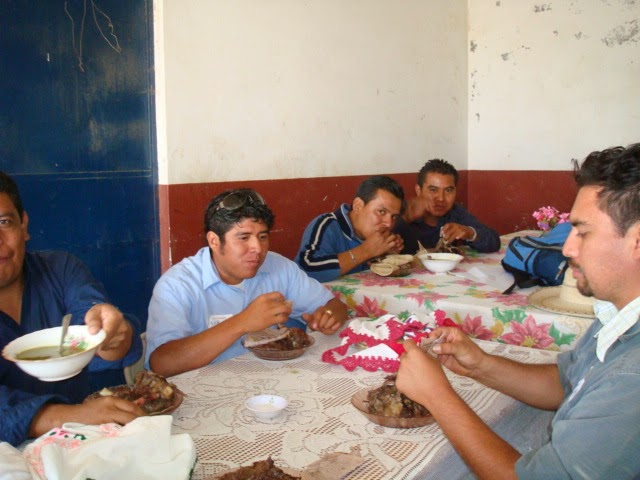
The community members always offer to feed these rural technicians who have traveled a long way. One day it was chicken in a red mole, with hot tortillas off the comal as the señora made them. No utensils, just tortillas as an eating medium. Oh, and a big soda. As Josafat says, there are many villages without a doctor, but you won't find anywhere without Coca-Cola.

In another community they roasted a sheep as a thankyou for the end of the season. It was a generous, though somewhat gristly meal, served along with green salsa, blue corn tortillas, and the sheep's liver, which I politely declined.
We are almost home around 8pm, and it's been a long 13 hour day. I want nothing more than to take a shower, drink some water, and go to sleep. But no, in one of the closer villages to Tlapa, another place the program works, we stop for beers. I try to refuse, and everyone is puzzled- why would you turn down drinking a cold beer with friends?

"Just don't say that the people of Guerrero didn't try to show you a good time," Josafat's coworkers tell me. Finally after a few rounds, and me translating some Alan Jackson song lyrics for them, we get back to the office in Tlapa... where someone suggests more beer! You have got to be kidding. We are meeting back at the office at 6:45 a.m., and I have a feeling that I'm going to get a little behind on my running schedule this week.