Thursday, June 13, 2013

Oregon Coast Bike Tour

I had never been to the Oregon coast, and never done any bicycle touring. I knew I wanted to do both, and liked the idea of not driving a car at all. My sweetie Max and I sat down a few weeks ago to devise a trip that we could do in five days of riding. We wanted to cover some ground but also not over-do our mileage since we were first-timers. Here's what we came up with!

DAY 1:
We put our bikes on the Metro bus to get downtown, then caught an early train from Seattle to Kelso/Longview in southern Washington. It was an unusually hot and sunny day for early June. We headed west on Highway 4 which runs along the north bank of the Columbia River. Behind us much of the time was a stunning view of Mount Saint Helens.
At the town of Cathlamet we turned south and crossed a bridge onto Puget Island. From there we took a little ferry (carrying 3 cars) across the big river onto the Oregon side.
At that point it was nearly 5pm, and we had been up since 5am and already ridden about 30 miles. We still had 30 miles to go, and they were going to be hilly with a headwind. But we really wanted to make it to Astoria the first night, so we pushed on, and rolled into town by 8pm. I was so exhausted I was ready to just go to bed without even eating dinner. It literally sounded like too much work to move a fork between a plate and my mouth. Luckily the Fort George brewpub was just a couple doors down, so we got some food and a delicious Spruce Bud ale.

DAY 2:

I slept in a little, focused on hydrating, slathered on some aloe, and the morning started looking up. We had not been diligent about sunscreen and got pretty burned the day before, so we were actually happy about the overcast weather. We walked around town, saw some historic sites, and drank some Stumptown coffee.

(Our bikes with Astoria bridge behind)

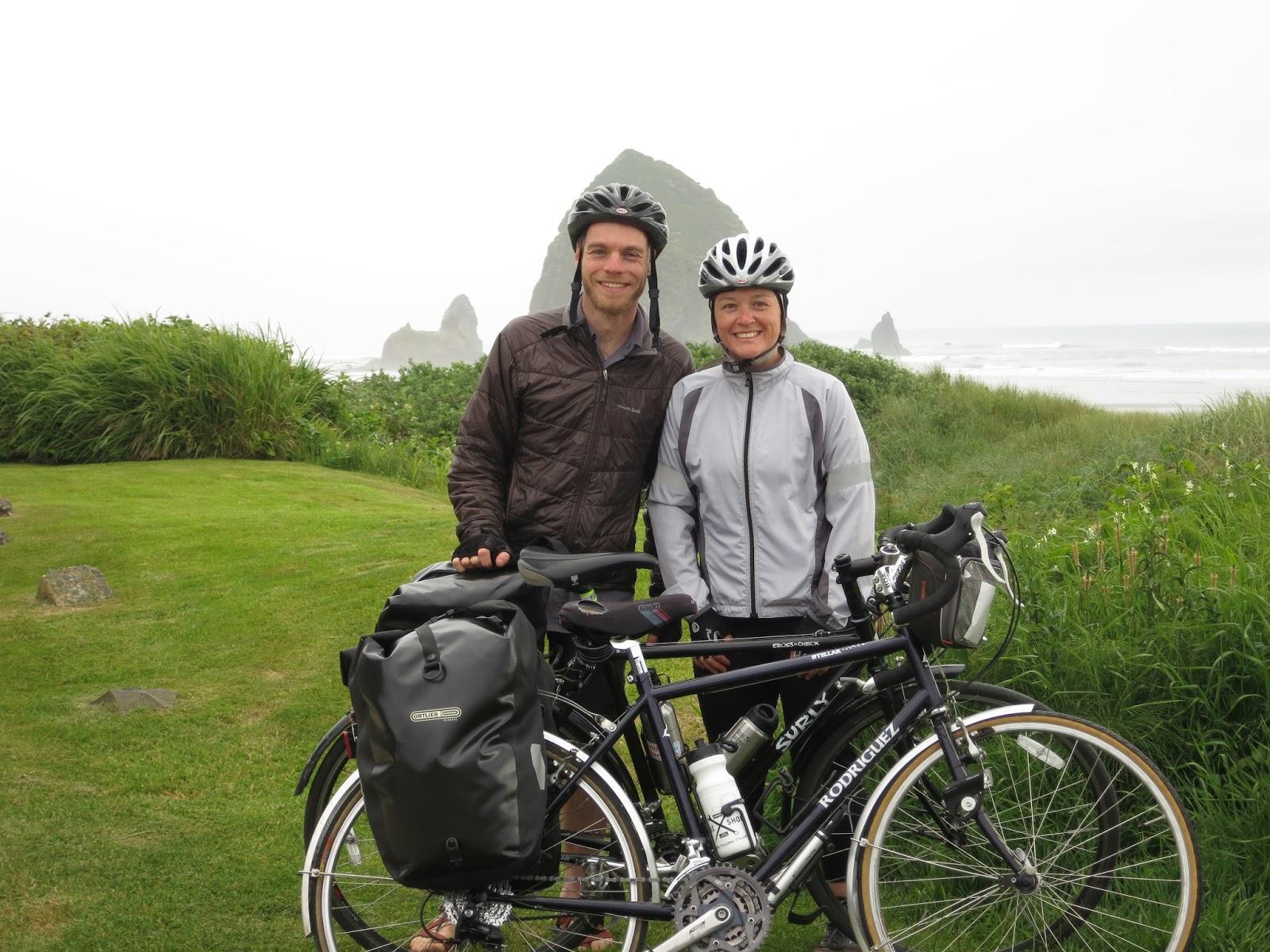
We headed south and west from Astoria on Highway 101. I have to say that even though signs started marking the "Oregon Coast Scenic Route", the ride was not that impressive between Astoria and Seaside. After a late lunch we rolled into a misty Cannon Beach and my bike met the ocean for the first time.


After Cannon Beach, the road got pretty spectacular. More sea stack rocks, and the highway curving right along the water. There was a narrow cave tunnel with a button to push to warn cars of cyclists. We rode on a bit farther that evening before setting up camp here.
 DAY 3:

We got an early start and decided we would stop and make coffee and breakfast at the next good view point. It wasn't long before we climbed up to this in Oswald West State Park.
The scenery was getting even more striking, and the weather had gone back to sunny.
We passed through some cute small towns and crossed beautiful rivers,
and really cool river estuaries.
We stopped at a Manhattan beach for a picnic lunch, quiet in terms of people but roaring loud waves.

As the highway went inland and we got into cow country, we had to make the requisite stop at the Tillamook cheese factory. I've wanted to go there ever since high school when I heard you could visit. We read a bike blog where the rider was not impressed with his visit, and my sister and niece also said they were disappointed when they went over spring break. But I thought it was an interesting, worthwhile stop. Then again, after riding in the hot sun since 7am, I probably would have loved anywhere where I could fill my water bottles, charge my cell phone, use the bathroom, eat local ice cream and get cheese samples.

There is a Three Capes Scenic Route which is a detour off the 101, but the road was closed. We ended up doing a small detour through Netarts and riding this lovely coastal road in the early evening.
We got to Cape Lookout which has a State Park with car camping, but they also do hiker/biker-only designated sites. We picked up some firewood and a six-pack and rode to our site with the essentials.


Our site was in the woods, but right off the ocean. It was a beautiful place, plus a neat way to meet other bike tourists. It sort of felt like an outdoor hostel for cyclists. People wandered by each other's camps to ask about the trip they were doing. We met two young women who had just flown in from the east coast to do a two-week trip to San Francisco. We met a retired man who was just beginning the TransAmerica route.

DAY 4:

We awoke to another sunny day. We made breakfast and coffee and fared the San Fran riders well before heading out. Within a mile, we started the biggest hill climb of the trip, about 830 feet in a mile and a half. We stopped part way up to catch our brea--, er, take a picture.
We rolled into Pacific City in early afternoon, and when we saw the Pelican Pub we knew had found our lunch spot with patio right on the beach.

We were feeling okay in terms of energy, but both with sore muscles, so we decided to take it a little easier today. We got into camp early and had plenty of time to stretch, write in journals, and make dinner.

DAY 5:

It was time to head away from the coast and back east. We had a really nice ride down through the Siuslaw National Forest over the coastal range. We were still lucking out with the warm and sunny weather.

The hills turned into the flat pastoral landscape of the Willamette Valley, with puffy clouds and a clear view of Mount Jefferson.
We got to Salem that evening after about 60 miles of riding. We were pretty happy to take showers, eat dinner, and have one last celebratory local Oregon microbrew before calling it a day.

DAY 6:

The next morning we caught the train home, changing once in Portland. It was a really fabulous trip with a nice mix of activity and downtime to soak in the scenery. While on the train, I was already thinking about what bike tour I might want to do next. But for now I'm going to enjoy being back in Seattle, and let my quadriceps take a little break.

Wednesday, June 5, 2013

Astoria Pre-Nostalgia

I'm about to leave for a 5-day bicycle trip in Oregon. My sweetie and I will catch an early train to Longview in southern Washington. Our first day of riding will take us along the Columbia River and end in Astoria, Oregon, which is almost on the coast. I've never been to Astoria, but I've heard mention of it a lot over the year from family members who would stop there on commercial fishing trips.

In the summers, relatives would tuna fish off the Pacific Coast from Washington all the way down to California. Astoria was one spot to stop and sell fish, unloading their big hauls that were waiting frozen in the hull. On my mom's first summer fishing when she was 16, she got arrested there and taken to jail when a local cop thought she was a runaway. They called her home number and no one answered. That is because, of course, her parents were in Astoria, and had splurged on a hotel after weeks on the water. My mom says she remembers the dubious jail toilet with its shoddy partition wall, and that the guards kindly lent her a book on Australia to pass the time. The police finally got ahold of her parents and released my poor mom before she had to spend the night.

My aunt said on her first summer fishing as a teenager, she was just getting her sea legs and then they'd go to Astoria to wait out big storms. They were fishing 100-200 miles off the coast, so getting caught in bad weather was no joke. Both my mom and her sister said they liked the town but they'd rather be out on the boat, on the water.

The older adults however, welcomed the chance to get off the boat, have a good meal and some drinks, often coordinating with other relatives from Seattle so that their boats were all in port at the same time.

There used to be a lot of canneries along the Columbia, but those were even declining by the time my mom started going to Astoria in the 1970's. The town probably would have become an even bigger economic port if it weren't for the Columbia Bar at the entrance of the river. This natural sandbar/shoal is miles long and apparently a treacherous place to try to get a boat into and a veritable ship graveyard. My great-uncle said he knows guys whose boats have gotten stuck on the bar. "These young guys come in thinking it's no big deal. But you have to have experience, and learn from some one who knows the bar. I learned from my dad."

His dad was my great-grandfather, a first-generation Norwegian-American who spent his whole life on or around the water. He lived on an island in the San Juans, but spent a good chunk of his life fishing salmon, halibut, and tuna in the waters between Alaska and California. He bought his own boat in 60's and then fished for several more decades. He named the boat "Vivian" after one of his daughters, my great-aunt. That boat was the life-blood of the family- bringing in money to support his 7 kids, and the place where the next couple generations would learn to fish. When my great-grandpa retired, the boat was maintained for many years and moored in the San Juans. Then in 1997, the diesel Atlas boat engine died unexpectedly, and shortly after my grandpa passed away after being in relatively good health.

The boat was fixed up and sold to a man who liked that style of fishing boat and wanted to live aboard. And you know where the boat is now? Astoria! So the plan is to try to spot it as we pedal into town tomorrow.

Tuesday, June 4, 2013

Found A Trusty Two-Wheeled Steed

I looked for a bicycle for over a year. I didn't think it would be too hard to fit the bill: a steel-frame road bike that I could use for commuting around town, that also had braise-ons and a triple-crank in case I ever wanted to do any touring. Oh, and if I ever did a casual triathlon I could use it for that too. I told my search criteria to a bike shop owner in Fremont last year, and she rolled her eyes and scoffed at me, "You're talking about 3 different bikes!"

Well, the reality was, I was not going to buy 3 bikes. The other reality was that it's hard to find ANY road bike as a 5-foot tall woman. I looked at about 6 different bike shops in Seattle and talked extensively with salespeople and it soon became clear that my options were pretty limited. There were a couple bikes I really liked the vintage aesthetic of, but even the smallest women's frames they manufactured were too big. There were a couple other options that were less stylish but totally decent, but because I need such a small frame, I need smaller wheels. I just couldn't stomach spending the money to buy a new bike that looked like I had stolen it from a 10-year-old. I wanted to adore my bike, not grit my teeth and bear it.

This past winter I was talking to a bike enthusiast and explaining my bike-shopping dilemma. "Do you ever check Craigslist?" he asked. Hah! Of course I did. And there is almost never anything for a small woman. If you are between 5'3" and 5'10" you will find a ton, but when you search "small" you will only find the occasional pair of shoes for sale. I have literally never seen a small road bike advertised in over a year of regularly checking. "Well," he said, "there are a lot of good used bikes out there. Don't give up hope."

That night I checked Craigslist for the first time in awhile. And there I saw, in a shiny golden halo of light, an ad for a small women's used Rodriguez bike, for sale at a bike shop in Everett. I made my roommate double-check my inseam so I could be sure of my stand-over height, and the next day drove straight up there after work. I rode the bike around the block and immediately loved it.

Rodriguez bikes are hand-built in Seattle. I had admired them ever since seeing the bike my 4'11" friend had custom-built for her. Even though the bike is used, I love that it is locally-made. The one I got is a Stellar, which was their women's specific model from 1996 to 2006 and came in 4 different sizes. Now they have a lot more sizing for women's frame geometry, but even so I feel like I lucked out in finding a good fit.
My roommate helped me do a little check-up (brakes, wheel truing, seat height, chain, etc.) and everything was great except we could hear a scrapey noise when the back wheel was coasting. My roommate thought it was a worn rear ball-bearing, but I took it to my local bike shop and it turned out to be a worn free wheel. I had to have that replaced, but otherwise everything is in good shape.

So far I've had a lot of fun riding around Seattle, out to Mercer Island, and on Camano island. I thought of touring as a hypothetical, sometime-in-the-future idea, but between a couple bike classes, the right riding buddy, and summer looming promisingly, I've decided to just go now! I've been working on getting some gear such as fenders, panniers, handlebar bag, lights, water bottles, spare tubes, and a pump. I've backpacked and been a bike commuter, so I'm hoping to roll those two experiences together. If all goes according to plan, I'll be leaving in a couple days for my first bike touring trip on the Oregon coast!

Monday, May 20, 2013

Spring Has Totally Sprung

It has officially been spring for two months. So... I may be a little behind schedule posting about spring, but better late than never!

First of all, spring means it's been a busy time in the garden. Here was an end-of-winter harvest for dinner one night, sometime back in early March. I had overwintered beets, arugula, kale, green onions, and also grown oyster mushrooms in the basement.
I pulled out the brassicas that were bolting, such as kale and brussel sprouts. But not before taking advantage of their little buds before they opened into flowers. I don't know why we don't eat these commonly, but they are really similar to broccoli raab and quite delicious. There are people who say you don't want to eat the leaves of kale and other plants after they bolt since they turn bitter, but I think you'd be hard-pressed to find any one who could taste the difference between bolted kale leaves sauteed in a dish.
Speaking of less-common veggies, I also harvested a bunch of stinging nettles. Once steamed, the leaves lose their sting and are incredibly nutritious, versatile, and tasty spring greens. I made pesto, and also a nettle-spinach spanakopita with a bunch of fresh mint from the garden.
Around the same time, the Smitten Kitchen blog had a recipe for very green and fresh Spring Vegetable Potstickers. I had never made potstickers before, but as she wrote, folding them is pretty intuitive and they turned out great.
A few weeks back I went a little crazy with rhubarb at the Ballard Farmer's Market, which left me wanting to explore new rhubarb dishes. Again from Smitten Kitchen, I found this fabulous recipe for Rhubarb Streusel Muffins which I made twice. 
There was also Rhubarb-Apple Crisp, a nice change from the usual strawberries. The most unique thing I did with those stalks though was to add sugar, water, a vanilla bean, cinnamon stick, and cardamon pod, simmer and reduce it into a sauce. Then I strained the liquid off and added club soda and vanilla ice cream for a Rhubarb Float. The chunky remainder of the sauce went on yogurt. So simple, but such a good idea!

I'm almost ashamed to admit this, but I had no idea until this past month that Ballard has a handful of awesome nano breweries. I made up for lost time by visiting several, including NW Peaks, Reubens Brews, and Peddler Brewing Co. I had an amazing oak barrel aged saison at Hilliards.
Last but not least, I saw this pig going through a coffee drive-through. 

Tuesday, May 14, 2013

Enchanted Valley

It's been an amazingly warm and sunny spring in Seattle. As soon as the weather got nice, I started getting antsy to get out of town and into the woods. It's still early for any higher elevation snow-free backpacking, but the Olympics are always a good bet for valley rainforest and coastal hikes. My sweetie suggested a weekend backpack to Enchanted Valley in Olympic National Park- 13.5 miles one-way to get to a valley with steep sides, numerous waterfalls, and an old forest-service cabin. It would be a decent amount of mileage but not much elevation gain, and the trail was snow free, so we decided to go for it!

Saturday began with breakfast on the edge of Lake Quinalt- coffee, egg breakfast sandwiches, and homemade yogurt panna cotta with the waves lapping on the shore.
Then we drove east another half hour or so to the trailhead. It started out as a typical beautiful Olympic hike- constant river sound, glowing moss, huge old-growth cedars, humid air, sculptural exposed root balls, and lots of little critters.


There were also a ton of creek crossings. Some had logs as bridges, and some were shallow enough to stone-step across in boots. But there were two crossings that were pretty dicey- either the bridge had washed out or the water level was higher than usual. There was really nothing to do but ford the ice-cold river. Luckily, we both had brought sandals, but even then the varying water depth and strong current made for a pretty sketchy crossing. We passed a couple people on the trail who had fallen in and saw several pairs of wet boots.

Also, after about six miles in, it became evident that no trail crew had done any maintenance yet after winter storms. The trail was in pretty rough shape. There were huge fallen trees constantly that we either had to go under, over, or around. In other spots there were piles of branches and debris. In one place there was a sign that said "Please Close Gate" but the gate had clearly been demolished by falling limbs and there was just a hole left in its place.


We knew there were remnants of an avalanche from a few weeks back from trail reports and the ranger. The mass of snow had melted considerably and was now melting holes into the river.
I have never seen a bear in the wild and really wanted to see one on this trail. Toward the late afternoon, we came across this guy! When he saw us he took off up the hillside. Later we saw another bear that was busy eating and didn't want to seem to leave his spot, and then on Sunday we saw a third! 
It was a gorgeous and varied trail altogether, with the early-season factors like high rivers and trail condition making it that much more epic. The icing on the cake was reaching the valley that evening, and getting to sleep in such a stunning and lush place. It felt like something out of Lord of The Rings, like we had truly stepped into another world or time.
The warm dry weather left shortly after we ate dinner, and all night it poured rain. In the morning, it was misty and wet, cool but not too cold. We made breakfast under the cover of the forest service cabin porch. Then we headed out back down the trail, in the rain but in good spirits. 

Wednesday, May 8, 2013

Round Two for Beekeeping

One year ago, I started my first hive of honeybees, making for a fun and challenging and fascinating spring and summer of figuring out how to be a beekeeper. I winterized the hive and closed it up in October, but unfortunately the hive didn't make it.

It was very disheartening, but losing hives is sadly par for the course. So I decided to try again this year, going for round two and two hives. I got my packages from the Ballard Bee Company, who pick up over 250 packages in California and bring them back to Seattle on a custom trailer. By the time I got to his house to get my bees, there was just this pile remaining. Just this pile of about a million bees.
I got one package of Italian honeybees, which is what I had last year, and one German variety called Carniolan. These varieties are the most popular for backyard beekeepers as they are both gentle and well-suited to the Pacific Northwest climate. The bees come as 3 pounds, which is roughly 10,000 bees. There is also a canister of sugar water for them to eat and one mated queen inside a little queen cage.
A couple friends came over as moral support and assistants for the install process.
It's important to get the bees out of the travel package and into their new home as soon as possible so they don't get too stressed. I started with the Italians, taking the sugar water canister out and removing the metal wire with the queen cage.

Only, there was no cage attached to the wire! I stared in shock at the lone metal wire as I replaced the canister so bees would not escape. Somehow in the transport process, the cage had broken free, and now as I looked into the package, I knew the queen was down there, not visible, under the pile of thousands of bees.

I didn't know what to do. It was one of those moments where I wanted to slough this problem onto some one else. Let some one more experienced take over. I imagine that is often what it is like to be a parent- not knowing what the right answer is, but knowing that you are the only one who can deal with something so you better step up. I sent a friend inside the house to get tongs, and decided to just try to find the cage that way. It took a few tries, more bees escaping than usual, and a good bit of adrenaline, but I eventually got her cage out!

Here's the Italian queen, alive and well.
We taped the wire to the cage and then I very carefully removed the cork stopper and replaced it with a marshmallow before putting the queen in the hive.
Then I dumped the rest of the bees inside, put on the cover, and left the package sitting open by the entrance where the stragglers would eventually find their way to their new home. You can see that the travel box still has quite a few bees inside. When I came out the next day, EVERY bee was gone. That means the dead ones too. It's normal for a few bees to die in transit, so the living bees had removed their bodies. They are just crazy hygienic like that. So cool.
Four days later, I checked to make sure the bees had eaten the marshmallow and queen was out of her cage. I saw both queens, alive and well. Here you can see her, larger than the worker bees and marked with a red dot. The official dot color changes each year, so apparently 2013 is red. Now the goal is to see the queen start laying eggs!

Saturday, April 13, 2013

Bad News For the Little Ladies

In the dark, damp winters of the pacific northwest, I think we are all trying to just make it through until spring. It's the same for the bees- they work hard all spring and summer making honey because they are going to hole up most of the fall and winter once the flower nectar is gone. They don't hibernate, but they generally don't leave the hive when it's below 54 degrees outside. Instead, they cluster together in a ball and fan their wings to generate heat, keeping the inside of the hive a toasty 93 degrees. So once the cooler weather came last October, I did what I could to prep the hive for winter, closed the lid, and hoped for the best.

Since you can't open the hive when it's cold, you just have to observe what you can from the outside. I started seeing a lot of dead bees in front of the hive, which is normal. Their population gets up to 50,000 or more at the height of summer, then will drop back down to around 20,000 in the low of winter, and these hygienic little creatures will not leave dead bodies inside the hive. I also noticed mold on the untreated wood of the inner cover. I put sticks in between the inner and outer cover to prop it up and create some ventilation. I drilled holes in the bottom screen board and slightly tilted the whole hive forward in case there was any condensation that needed to escape.
But by the sunny days in February and March, I wasn't seeing any activity at all- no solitary scout bees out flying, no new dead bees outside the entrance. When I finally peeked inside on one of our warmer late-winter days, I was devastated to find that the colony had not survived. It was terrible. There were petrified bees half-inside the comb cells, and a pile of dead bees on the screened bottom. There was larva half-developed that had turned to a stinky caramely goo. It was like a bee horror movie.

When I told friends over the last few weeks about the loss, they usually ask, "Why did they die?" Ha, that is the million-dollar question! It's hard to say exactly. I know my hive had a lot of moisture in it and subsequent mold, but I'm not sure how much that may have weakened them. I already have a plan for a few things I would do differently next fall in winterizing the hive. What I do know is that it was a really hard winter for bees in general. Many experienced beekeepers that I talked to lost a shocking number of hives this winter.

There's been a lot of coverage in the news over the past few years about Colony Collapse Disorder and the dwindling numbers and vitality of many kinds of bees. For decades it's been a mystery, with many factors being considered. In the Global Research article Genetically Modified Crops and the Decline of Bee Colonies in North America originally published in 2008, scientists looked at the possibility of Varroa mites, parasites, cell phones, and genetically engineered "terminator seeds" as culprits. They concluded at that time that genetically engineered crops were the biggest problem. Also, a nifty US crop pollination chart:
However, it wasn't until about a year ago that more conclusive evidence started coming out linking agricultural pesticides to the disappearing bees. At the end of March last year, the New York Times published an article about bees and neonicotinoids, which wikipedia describes as "a class of neuro-active insecticides chemically related to nicotine. The development of this class of insecticides began with work in the 1980's by Shell, and the 1990's by Bayer... Neonicotinoids are the first class of new insecticides introduced in the last 50 years, and the neonicotinoid imidacloprid is currently the most widely used insecticide in the world." 

In that article, Two Studies Point to Common Pesticide as a Culprit in Declining Bee Colonies, it says, "The authors of both studies contend that the results raise serious questions about the use of pesticides, known as neonicitinoids." It goes on to say, "But pesticides are only one of several likely factors that scientists have linked to declining bee populations. There are simply fewer flowers, for example, thanks to land development. Bees are increasingly succumbing to mites, viruses, fungi, and pathogens."

So we finally are starting to get a handle on the causes of the bee epidemic, namely genetically engineered crops and insecticides. But there needs to be a lot more research.  Research should probably not be conducted by one of the largest producers of pesticides and GE seeds, right?! But in April 2012, there were reports of just that when Monsanto Buys Bee Research Company.

Here is another good one from September of last year, Bee Deviled: Causes of Colony Collapse Disorder. Author Annie Spiegelman writes, "If you're not a huge fan of the bee, why should this matter to you? Well, if you like to eat food, you should be concerned. Besides gathering nectar to produce honey, bees pollinate agricultural crops, home gardens, orchards and wildlife habitat... It's estimated that about one-third of the human diet is derived from insect-pollinated plants, and three-quarters of all plants on the planet depend on insects or animals for pollination." She goes on to interview the co-director of the Pesticide Action Network about neonicotinoids.

Then February rolled around, when beekeepers from every U.S. state drive millions of hives to California to help with the largest pollination effort in the world. Any idea what crop that is for? You could probably guess from the chart above: Almonds. But this was an unprecedentedly terrible year for commercial beekeepers losing hives. Before Colony Collapse, it was normal to lose 5-10% of your hives. Then by 2005, one-third losses were becoming the norm. But this winter, it was up to 40-50%. This is a recent article from a few weeks ago specifically about this issue, Mystery Malady Kills More Bees.

And in early April this same issue of the massive pollination fail for almonds in California was addressed in Dan Rather's "Buzzkill". If you don't read any of the other articles in this blog post, I would HIGHLY recommend watching this informative segment. It's about 50 minutes long but good all the way through. And I couldn't help but think: buy almonds now. My prediction is that the price will skyrocket soon as this was the first year without enough bees to pollinate and the harvest will surely be much smaller than usual.

So, that's my attempt to answer the question as to why my bees died this year. Both backyard and commercial beekeepers are looking at a one-third loss as standard for any year. In fact, the beekeeper/supplier I bought my equipment from recommends starting with three hives since you will probably lose one. Last year it felt like a bit of a financial and time investment to have more than one hive as a new beekeeper, but this year I feel ready to add a second hive. So two new packages of bees will be arriving in two weeks!

My final thought is that we are finally seeing the bee decline as a real problem, and with some nameable causes can take steps to prevent further damage to the honeybee population. This article came out just a couple days ago about a supermarket in the UK banning any of their produce suppliers from using neonicitinoid pesticides. Sure, it may be only one grocery chain, and not even in the United States, but it definitely shows a growing awareness and a step in the right direction.

Monday, April 1, 2013

One Year House-Aversary

Many of my friends were skeptical. "You'll be bored of living in Seattle in three months, and off on another adventure!" they said. But two winters ago, I knew I was ready to stay in one place for awhile. And I knew that place was the fair city where I was born. So I looked for a rental... and looked, and looked. It took about three and a half months and viewing maybe a dozen places, but I finally found the right spot. Today marks the one year anniversary of moving into this home. And you know what else? That is the longest I've lived in one spot in TWELVE years. 

And I could not be more grateful. One year later, I'm not looking to move. I feel like I've just scratched the surface of the city. And I love my roommates more than ever. First of all there is Simon, who is like a brother. He gives me an excited greeting when I get home, and always has time to chat. We often stand in the back yard together and talk about our visions for the place as I drink a beer and he offers tools and know-how. One night awhile back I got home after a sad break-up talk with my then-boyfriend, and Simon knew something was wrong. He gave me a big, long hug then said brightly, "Hey, want to go out for Chinese food?" Yes, yes I did. 

Then there is Loren, who I think of more as the uncle of the house, and is the most awesome roommate in terms of outdoor gear. Last year when I was getting ready to hike up to Camp Muir and buy a pair of gaiters, he was like, "Wait, I have an extra pair of women's gaiters you can have!" A couple months ago I was on my way out the door to hike Mt. Si and he was like,"Have you ever used Yak Trax? Here, borrow these for the snow at the top!" He is also great about helping me with bike stuff, like tuning up my mountain bike before Burning Man as well as the road bike I just got.

Sara is my fellow lady roomie, and she is a funny and creative force to be reckoned with. She is a fabulous story-teller. She bakes amazing cakes and cans sauces and pickles and makes her own bitters. Once she spent hours making and reducing a 3-part classic French sauce, finally eating it after 10pm. The next day, I told her I was having a friend over for dinner and didn't have a plan of what to make. "Use the rest of my sauce in the fridge!" she insisted. Wait, really? Right before St. Patrick's Day she said, "I'm going to a party and want to wear a green dress, but I don't have one." So instead of just buying one, she went to the fabric store and came home and sewed a beautiful spring dress in a day.

All three of these folks are so respectful, generous, tidy, laid-back, and genuinely kind. We are often busy and do our own thing, but we also enjoy roommate time occasionally. This was our first backyard BBQ and fire of the season on the spring equinox, with a couple of friends over.
I also love living here with ample space for backyard projects. For all the farms and gardens that I've helped with, I've never had a garden space of my own for more than one growing season.
In fact, I got so zealous about growing veggies last summer that I ran out of space in the beds, and started a driveway container garden.
We also have a fire pit, giant trampoline, carport, roses, compost piles, chicken coop and run, and a tucked-away corner to keep my beehive out of the way.

Heck, with one year here under my belt, maybe I'll go for two! I can't see any reason to leave any time soon.