Sunday, August 29, 2010

Seoraksan and Summer's End

Growing up in Seattle, summer always came too late and ended too soon. Those few glorious months of heat would leave all residents, adults and children alike, wanting a little more sun.

So it feels strange, almost sacrilegious, to admit that I'm ready for this summer to be over. Summer is a different beast here in South Korea- a hot, humid, relentless one. In the Pacific Northwest, even a scorching hot day usually cools off at night. Not so here. It is always warm, and on bike rides home even late at night I will be dripping sweat. I literally haven't worn a pair of pants or a long sleeve shirt in months. I miss my pants.

Another reason for being ready for summer to end is the lopsided work schedule. In the summer we had a lot of "office time", aka "desk warming", aka having to be at work with not a lot to do. I tried to stay busy with productive activities, but most teachers end up painfully bored.

On the flip side, we also taught a 3-week summer camp, and I was in charge of the drama classes. We had to put on a short English play with 64 middle school students. It was an absolutely crazy 3 weeks of nonstop work. Imagine putting on a full production with that many middle school students in the U.S... then imagine it in a second language. Holy cow. Luckily my Korean co-teacher had taught drama in the past, and was an amazing source of ideas and experience. Other staff helped as well to fill in the gaps where I didn't have the time or knowledge: two teachers choreographed and taught the dances, the music teacher practiced the songs in his music classes, an intern who is going to Stanford this fall translated the whole script for the parents; a design intern painted the backdrop and made props; another intern downloaded sound clips and ran the audio. In the end, everything came together amazingly well, with many parents attending as well as the Head of the Provincial Board of Education and the Mayor of Gunsan!

Before settling in to a steady, cooler fall routine, I wanted to take one last trip. Seoraksan is a huge National Park in the northeast corner of the country. It has beautiful peaks, waterfalls, hot springs, temples, rock faces, and caves. Summer is the high season to visit, though fall is very popular also when the leaves start to change. I have gone on many smaller hikes this summer and had limited visibility in the humid air. I was really hoping for some good views, knowing that it's always a gamble with the weather. I was also really excited to "backpack" as much as is possible in Korea. As far as I can tell, there are no real "back country" wilderness areas. The national parks are large, but they will have railings along the trails and crowds even in the deepest areas. Camping and cooking and swimming are prohibited... which is good for preservation, but bad for folks who seek a less controlled mountain experience. Some parks, including Seoraksan, have shelters though. These are rustic structures with long wooden bunks, a cooking shack, and toilets, and can be reserved ahead of time. So our plans was to start in the northeast part at the Seorak-dong entrance, backpack all day up to the Jungcheongbong shelter, hike up Daecheongbong peak, then hike out the next day to Osaek to the south.

My friend Bryony and I arrived by bus in Sokcho in the northeast coast of Korea about 7 hours after leaving Gunsan, then took a city bus to Seorak-dong. We were going to camp there but it was pouring rain so we decided to check into a hotel instead. We walked up to the ranger station which had just closed for the evening, but luckily they came out to talk to us anyway. It turned out that with all the heavy rains the trail to Jungcheongbong and Daecheongbong were closed. They said maybe the trail would re-open Sunday. It was Thursday, so we definitely couldn't wait that long. This is our sad face after we realized our backpacking plans were foiled.

We were bummed, but we both kept a positive and flexible, "Let's make the best of it!" attitude. There was still a lot of hiking to do from the Seorak-dong entrance, including temples...

...a steep hike to Ulsan Bawi and decent views when the clouds parted...

... and a beautiful hike through a river valley to a cave in a high cliffside that is also a Buddhist shrine.

We also hiked to a waterfall that evening- a flat walk that felt like nothing after our steep trails of the day. We had gained over 1,400 meters of elevation (4,200 feet) that day. I woke up early the next morning not feeling sore anywhere... except my calves. We managed to hobble out to catch the bus back to Sokcho and around the park to the Osaek entrance. It hadn't rained the day before, so we were hoping the trail to Daecheongbong would be open. By the time the various bus connections got us to the trailhead, it was already noon. The ranger asked if we planned to get to the peak and back, and we said yes. He looked skeptical. "It's 8 hours roundtrip," he said. "Seven!" I countered, as though we were bargaining. "We'll be fast, we have lights, no problem!" Bryony and I assured him. We really didn't want to hike in the dark, but we had come so far to get here that we had to attempt it. We had also agreed that we could tap out anytime if we were too tired. "Where are you from?" he asked. "Mi-gook!" (America) I said. I don't know if that swayed his acceptance of our crazy plan (we didn't mention that Bryony was British) but finally he nodded and said, "Hurry".

So with calves already aching from the day before, we powered up the stone staircase of a trail. In the U.S. we would make switchbacks, but in Korea it's straight up the mountain. We barely stopped to rest as we ascended 1,000 meters (3,000 feet) in the worsening afternoon weather. It was getting cooler, foggier, and looked like rain could start any moment. We reached the top in 2 hours 45 minutes, tired but exhilarated. We were on the 3rd highest peak in Korea and couldn't see a thing!

It began raining on the descent. We hoped the same ranger would be at the trailhead when we returned so we could gloat over our triumphant 5:20 time, but it was all new faces. We managed to catch the last bus back to Seoul, buying our ticket at a tiny ticket office which was also a convenience store. The ajumma let us change clothes in her back room before settling into the bus dry, exhausted, and happy.

Friday, August 20, 2010

Actually an Ajumma

I'm not even 30, but sometimes I have the feeling that I might actually be an ajumma. Ajumma means married woman, with more of a connotation of old woman, in Korean 아 줌 마. But they are not like older women in the U.S., or anywhere else for that matter. They are a whole subcategory unto themselves, defined more by style and attitude than age necessarily. They are usually short, fast walking, no-nonsense, fearless women with permed hair, track clothes, floral prints, and big sun visors.

Have you ever heard that poem "When I am old I shall wear purple" about a woman who looks forward to doing whatever she wants when she is older? That poem reminds me of ajummas. It's like these women have spent their whole lives working, raising a family, living in an apartment, looking perfect, and wearing high-heels... then one day when their children are grown they realize they can take some time for themselves and finally do what they want. And they do it unapologetically.

Anyway, let's look at the evidence as to why I might be an ajumma at heart.

1. I like to hike. You don't see many young women hiking in Korea. And the few that I've seen on short trails have been in heels, no joke. The other day on a trail I saw a young woman walking barefoot, carrying her strappy heels, which was actually more practical. But ajummas wear full Korean hiking gear- synthetic pants and jackets, visors, face masks, gloves, and boots- usually all black with one matching accent color (ie hot pink trim on visor matching the boots matching the pants' racing stripe). I'm not that hard-core, but I do like to get out of the city and explore as many provincial and national parks as possible. Usually while being passed by an ajumma on the trail.

2. I always think things are too loud. I feel like an old person complaining about noise, but REALLY. There aren't noise ordinances, so vendor trucks will drive around selling whatever, blasting their megaphone at 7am. Neighbors' TVs blare. Or they talk really loud after getting home from a night of drinking soju. Is a little peace and quiet too much to ask?

3. I iron regularly. Okay, so every one has to do this because no one has dryers. But then the other day I lint-rolled my ironing board. I have never done that. I felt old.

4. I like to garden. This is definitely an ajumma activity too. I mentioned this before, how there are little guerrilla gardens everywhere in this city. It's almost always older women working the land, digging and planting and wedding and harvesting as you walk by on the sidewalk. Occasionally you see a man, but never any one under 50. Here are some of the gardens I've seen around town.


This garden is larger than usual, and I love that it's pretty diverse, and right next to the Ritz-Plaza hotel.

And if some one can't find actual land to grow food on, they make due with container gardens. This is in front of a business on the sidewalk, pumping out a fair amount of peppers and tomatoes and herbs.

We have this extra land on the side of the school, so my Headmaster let me use whatever I wanted for my own garden venture. The soil has a lot of heavy clay and is really rocky, but I wasn't going to let that stop me! I did a little amending and hoped for the best. It is my little oasis back there where no one else goes- I would sneak out at a quiet moment to check on the garden, weed, water seedlings, watch spiders, and just enjoy having a "yard" in this land of apartments.


I grew some cabbage, lettuce, other spicy greens, cherry tomatoes, sunflowers, peppers, and herbs. I got a little harvest from everything, the most successful being the peppers or gochu 고 추.

5. I want to make traditional food. Kimchi is top on my list to learn to make, and nothing says ajumma like homemade kimchi! Fall is the time to do it, as it was traditionally a way of preserving greens for the winter. In my ideal world I will have a huge bed of cabbage ready by November so I can harvest my own for my kimchi.

A few weeks ago I went out to the countryside to the home of my Colombian friend's Korean in-laws. They have a bit of a farm, and it was SO nice to be somewhere with some land. Our plan was to make traditional Colombian empanadas and Ecuadorian torta de choclo (corn cakes) with corn from the property. They had quite the homestead there with a huge garden, chickens, rabbits, and preserved food all around like drying peppers, garlic, and rice, plus frozen corn, and stored potatoes. The ajumma of the house (mother-in-law) used to run a restaurant, and shared a delicious lunch with us, then set about making kimchi the rest of the day. She sent me home with a huge bag of fresh sweet-potato-greens kimchi. The ajoshi (old man; my friend's father-in-law) is a Christian pastor who visited partner churches in the U.S. When they told him I was from Seattle, he took out a business card from a church outside Bellingham, the address on the Mount Baker Highway! Seriously, what a small world.

And Maria and I gorged ourselves with tomatoes from the garden. That means you've officially experienced summer, and it's okay if fall is on its way.

Monday, August 16, 2010

Couples Outfits


Okay, this post is for Elizabeth because she wanted more info, and is my best blog reader and commenter. :)

So Koreans are pretty contemporary when it comes to marriage age. They encourage both men and women to go to college and get established in a career before starting a family. Around 25 is a good time for women to start getting married. The problem is, by 30, you are considered to be past marital prime. I mean, I'm 28 and feel the slight occasional pressure to get married and make babies, but it's not as if my window of opportunity will close in 2 years. But in Korea these 5 years are key. Consequently, relationships progress very quickly and many couples get married within a year of dating. It's looked upon very favorably by society to have a partner, so it ends up getting flaunted in public. There isn't a lot of making out in parks or anything like I've seen in many parts of Latin America. But there are couple's photo booths, romantic heart sculptures in the park, love rocks, and yes, matching clothes. The most basic couple's getups are matching shirts, but you will see whole outfits, or a man's shirt matching a dress. I see at least one matching couple a day if I'm in a downtown or crowded area.


Oh yeah, matching underwear too.

Korean Fashion

Korean Fashion is a style all its own. Here are some of my main observations over the last 5 months.

1. The women are very feminine.
Unless specifically going to the gym or hiking, I'd say the women in general dress more feminine than women in the West. And actually, you see plenty of heels and skirts in the woods. I find Korean women very beautiful, and they definitely make an effort to be "pretty". I think this picture typifies a young Korean woman- dress, long hair, perfect make-up, bows, flower, pearls. They are very well put-together. (Except for the mismatch, see #6) Not that they don't wear jeans and t-shirts, especially more here in the small city of Gunsan than somewhere more cosmopolitan like Seoul, but overall short hair, no makeup, pants, and tennis shoes are not as common as on an American woman. (Photo from YoCo Fashion)

2. The men are pretty feminine as well.
I love the men's style here. It manages to be funky, professional, and metrosexual all at once. For a country where gender roles are strict and homosexuality is outlawed, it's a little surprising to see man-purses, guy-liner, and impeccably styled hair. Boys have golden years in fashion, usually around 18-25, when they no longer have to wear high-school uniforms, but they also don't have to look too professional yet. Once entrenched in the working world, their style gets more subdued.


Have you ever seen celebrities wear these pants that are loose at the thigh and tight at the bottom? I think they're called harem pants. I say celebrities, because most average people can't wear them. You need really slender hips to pull them off. Not surprisingly, they look great on Koreans and are fairly common. I even saw a guy wearing a pair the other day. Whole outfit: capri harem pants, a ribbed tank-top (I hate saying wife beater but you know exactly what I'm talking about), plaid slip-on loafers, and a thick, studded leather bracelet. He looked great.
3. High heels are a must.
The Korean woman's ability to walk in heels is astounding. It's like they were all stepped out of Lady Gaga's Bad Romance video. They walk all over town, and I have seen them book it when necessary. I recently saw a young mom walking with a small baby in a kangaroo sling in front of her body, also holding the hand of her 3 year old daughter... while wearing incredibly high heels. You see pumps and sandaly heels, but more popular are thick-strapped, boot style heels, like this. And yes, you frequently see high heels at the beach. (Photo by Sarah Shaw)

4. The standards of modesty are different from the West.
This is a comic from ROKetship on Facebook that illustrates this point perfectly. In Korea, there is no such thing as a skirt or shorts that are too short. Showing lots of leg is totally acceptable, even at work. However, in the U.S., such display is considered provocative. Conversely, at home, showing shoulders, collarbone, and moderate cleavage is totally okay. But here, a tank top, especially on a foreign woman who tends to have larger breasts than the average Korean, is fairly racy.
5. Office-wear is its own genre.
My last two jobs in the U.S. were barista and farmer, so I'm not exactly an expert in contemporary office styles. But there seems to be a sort of overlap between work clothes and non-work clothes, in a style I would dub 'sexy office' or 'business glam'. Sometimes my coworkers look like they are ready to go straight to a cocktail party after work.


6. An outfit is nice as long as the separate pieces are nice.
I see this more on middle-aged Koreans than younger ones. Seriously though, there can be quite the mismatch of styles, though it's clear that each article of clothing is expensive and fashionable. For the most part, Koreans can totally pull it off looking good too. Well, maybe the women more than the men. I can't tell you how many times I've seen men wearing nice silk suits with plaid pants and a DIFFERENT print of plaid shirt or jacket.

One day I saw a middle-aged woman wearing black slacks, and a nice dark purple silk blouse with ruffles up the front. In the U.S. this would have been a complete outfit, but here she added a fitted short brown leather vest. Another time I saw a similar aged woman in capris, a business jacket, and a 1970's-looking flight attendant scarf riding a lime green cruiser bicycle with a basket on the front full of cabbage. Not bad, not good, but definitely makes you go, 'hmmm'.

Here's another outfit on a younger woman: skin-tight blue polyester mini-skirt, cream colored cotton shirt tucked in, with a black satin bow over the chest, cream high-heeled strappy shoes over purple ankle socks, and to tie it all together, an oversized red leather purse. Another: floral ruffled shirt, fuscia denim short shorts, and high heeled sneakers. Another: flowy black genie pants, striped shirt, floral blazer, and black tennis shoes with gold swirls.

7. Couple's outfits.
They wear matching shirts, sometimes whole outfits. Commonly. That's all I'm gonna say about that.
(Photo from lajavasyle)


8. I'm not immune to the influence.
All clothes I have bought since coming to Korea have either flowers, ruffles, lace, or sparkles... or some combination thereof.

Tuesday, August 10, 2010

A Truly Great Nana


This post is in memory of my Great Nana Florence. She passed away peacefully at 90 years old. I really wish I could teleport home for a few days to be with my family right now. International living definitely has its drawbacks at times. She was very ready to pass on, so that is somewhat comforting, but of course you can never be completely ready to say goodbye. I will miss her gentle but powerful presence in our family. She was incredibly sweet and kind, but she also raised 7 kids on a rural island and had to be tough as nails. Here are a couple pictures: above with my niece Kali, and below with the 5 generations of women in the family (my niece, sister, mom, grandma, and great-grandma). That's right, she is holding her great-great-granddaughter Emma.

I'd like to dedicate a song to my Great Nana. It's called Ella Mae, by Greg Brown. There is a version where his daughters sing it in harmonies, and it is really beautiful. The song reminds me of her- maybe not in the details like the name of her husband or dying shortly after him- but in the general way of life that it portrays. A steady, hard-working time when people lived closer to the land, watching birds, digging in the garden, smelling like bread, and being a beacon for their family with their love.

Ella Mae - the redwings returned today
A little rain fell in the morning
The afternoon was clear
An' that song you loved to hear
Was filling up the fence row where the birds all go
To talk over their long journey and sing.

Ella Mae - all the gifts you gave
Tremble in my life like a startled deer
You gave me my Pa
Who is in me as you are
And the southern piney hills
The clear water and the running rills
That tumbled through the lives of us all.

Six big men and one big strong woman
You and little Grandpa David raised up there
They all had families
We all come back to see you
You hugged us all in turn
Cocked you head and said we'd grown
And touched us with your hands
That smelled like bread

Ella Mae - it's a clear warm summer's day
The young birds are trying out their wings
Ah it's something to see them try
To get up there and fly
And my own child is bound to do the same
Today she learned three birds' names.

Ella Mae - I can see you plain as day
Sailing out like a ship to your garden
In your old wide-brim straw hat
With a long handled hoe in your hand.
pausing at the gate I see you look south to the pond
A long time quiet smile on your face.

Ella Mae - when your David went away
After cutting brush all day long
Well, your life just slowly closed
Like a worn out autumn rose
You could not find the bread
You could not make your lonesome bed
Or really do a thing but rise and go.

Ella Mae - the redwings left today
Passing in a long cloud of wings
They're headed down your way
They'll be there in a couple of days
They'll sing that song you loved
As they fly above
Your resting place by David in the pines.

Wednesday, July 28, 2010

China


I have never gone on a trip without packing pants.

The weather forecast for Beijing promised to not get below the 80's, and I believed it. People warned me about going in the summer heat, but I shrugged them off. My vacation was for the end of July, and I had to go somewhere! Whether I stayed in Korea or went to Japan or China, it would be miserably hot. But I really had to fight my Washingtonian sensibilities for packing. Even in summer, I would always pack pants, a warm top layer, a rain jacket, socks, and tennis shoes if I was going overnight somewhere. This time, my backpack was barely half-full with tank tops, shorts, and sandals.

I spent a week in Beijing, and Facebook was blocked as well as blogspot! I wanted to write at the time, but now that I'm back in Korea, I don't know where to start. Overall it was a good trip, but definitely hot and humid, conditions which were compounded by the pollution. Here's some highs and lows...

Highlights:

GREAT WALL OF CHINA: I avoided the most touristy spots and did a hiking tour from Simatai to Jinshanling. This was probably my favorite day of all. I got to the meeting spot a little before 6am and had a breakfast of watermelon and fresh steamed dumplings with a French couple on the tea house porch. By the time we got the rest of our group and drove out to the wall, it was nearly 10:30. There were many Europeans and also some Americans; tourists as well as business students and English teachers. It was about a 30 minute hike up continual stairs just to get up to the wall.

Once on the Wall, it was pretty spectacular. It stretches and snakes away from you, dotted with watchtowers in various states of decay. Unfortunately, the visibility was not very good, and I couldn't see super far, and my camera could see even less. We walked 7 kilometers on the wall, passing maybe a few dozen other hikers coming from the other direction. It was pretty rough terrain between the uneven stone, steep crumbling staircases, and blazing sun. We descended to have lunch and followed by a content and sleepy ride back to Beijing.


SUMMER PALACE: This royal summer dwelling is more than a palace; it's a whole complex of buildings with temples, gardens, walkways, and a huge lake. I preferred it to the Forbidden City, which although impressive and beautiful, is very linear and manicured. (In the Forbidden City, you pretty much have to walk straight through and see things in a certain order, and it was extremely crowded. There is a Hall of Supreme Harmony, but it was so packed I couldn't get close enough to even see inside the hall without getting pushed and elbowed. Hah, not very harmonious. But it is beautiful with impressive architecture, you can see below.)

Anyway, I liked the wildness of the Summer Palace; the rocks to scramble on; the meandering pathways; the shade; the boats floating about; the dispersed crowds of people. But again, as you can see from the pictures, the visibility was not great. One guide referred to the "glistening lake", which I'm sure would be accurate when you can see it. Yeah, that's the lake through the gate in this picture. Yeah, all that white.


BIKE RIDING: I don't think I would have been as confident about riding a bicycle around Beijing if I hadn't already been riding a bike in Korea. I've had time to get used to the craziness. And actually, I was pleasantly surprised by how easy and logical 2-wheeled navigation was in this mega-city. Many people are on bicycles and scooters, and most major streets had huge separate bike lanes, as well as bike crossing lights. And when in doubt, I just crossed the street following closely behind Chinese cyclists. Wedged between the big 8-lane roads, there are still traditional alleys called hutongs, so I spent a day riding around hutongs, sort of following a route and sort of getting lost and found again.

FOOD: I ate some freakin delicious food. First of all there is the street food, which I'm a big fan of. Gastrointestinally risky, but so good and varied. I really liked these little yogurts, which they sell in reusable heavy ceramic cups, so you have to drink them at the shop you buy them at.

And dumplings...

And all sorts of meat-on-sticks...

Including fried sea horses...

Then there was the night market. I love night markets in general- that people are out and walking around in a safe public space. It feels like Europe. It feels vibrant. The smells are strong and new and distinct. There were scorpions and all sort of unusual foods, but I stuck to tamer fare, like bean sprout burrito thing, and noodles and gyros and pear juice.

I had some really nice sit down meals too. The first night I met two French guys at my hostel and we went to this nearby hole in the wall and had a feast. Beef and onions, chicken, pork with peppers and mushrooms, dumplings, rice and beer all for about $5 each. Then of course I had to eat Peking Duck, which I did on my last night with my British friend, and was not disappointed. The very best part was that they make a stock of the leftover duck and bring it to you at the end of the meal. It was really simple, just duck and cabbage and I don't know what else, but it was AMAZING. Maybe in the top 5 most perfect-tasting soups of my life, and I can't remember the other 4.

NEW FRIENDS: I have friends in Korea of course, but while traveling in a different country, I was exposed to a wider variety of foreigners. It was just nice to have that change of pace. There were a lot of French staying at my hostel, and in all of Beijing in general. There were a handful of Spaniards and Argentinians as well, so I got to practice plenty of Spanish. I met 5 other Americans who were teaching English in Korea and just on a short vacation like me.

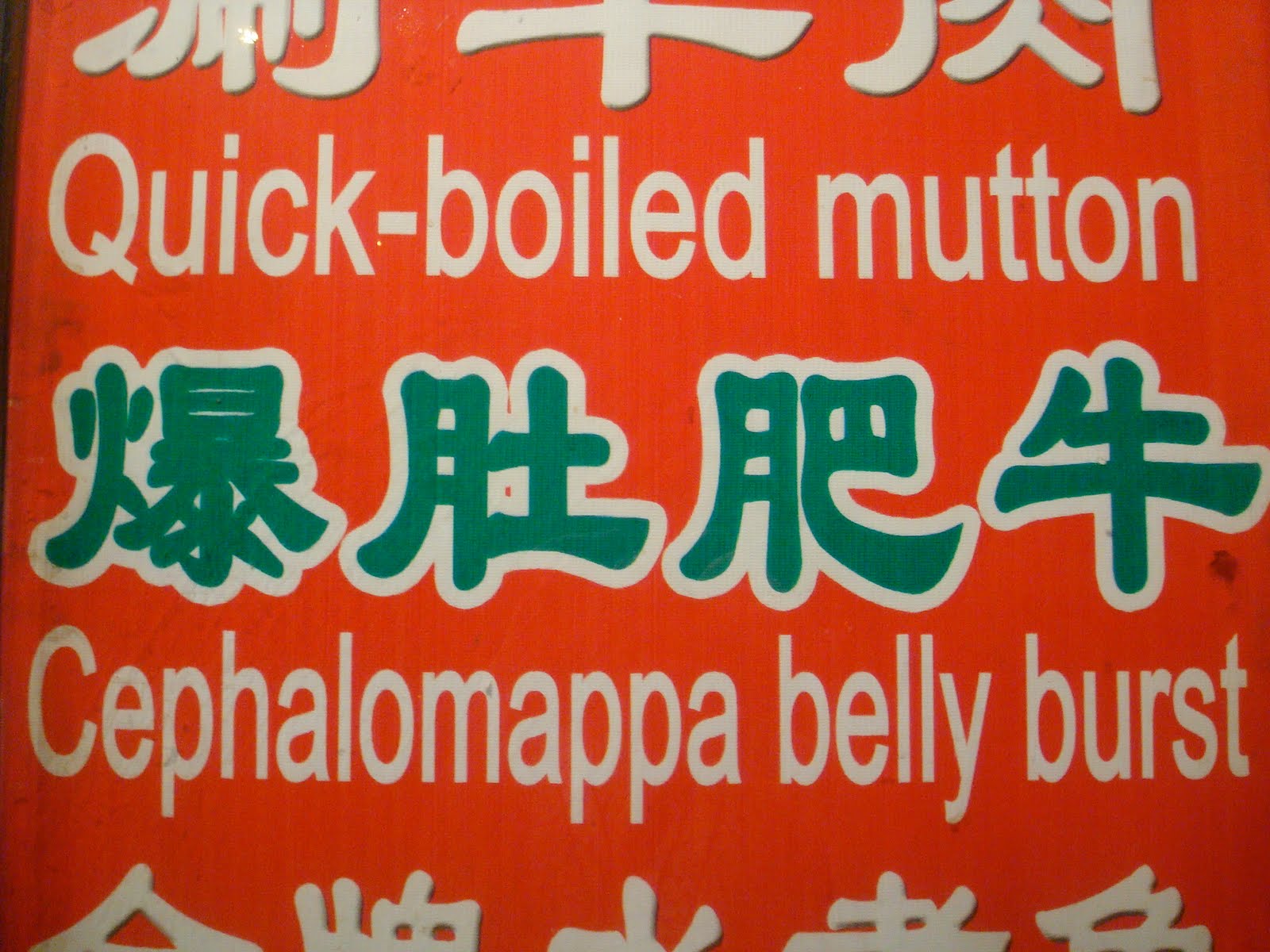
INGRISH: I am amused to no end by the funny English translations in Asia. Most of these are from menus.


Lowlights:

NO XIAN: The biggest let-down was that I didn't get to go to Xian, the city with the Terracotta Soldiers. It's an overnight train ride from Beijing, and I booked my train tickets as soon as I got to China, and was barely able to find room. Usually you need train reservations about a week in advance. I was looking forward to going to a smaller city and seeing this infamous army. My mom has a set of small terracotta soldiers of different ranks in different positions, and those men and I have been staring each other down for about 15 years from their place on the shelf.

I took my first bus in Beijing to get to the train station with no problem. It was PACKED. You have to elbow your way just to get through the front door, and then go through security and push people to get your bag on the X-ray belt. Everything takes longer in crowds, but I had arrived an hour early which I thought was plenty of time. I asked at the Station Master's desk (after lots of waiting and then some elbowing) which platform I boarded on, and she just looked at my ticket and shook her head. "Ticket office downstairs" she said. I didn't know why. I got the ticket through my hostel, but maybe it wasn't the final version of the ticket?

Downstairs there were about a million ticket windows, each with a line of 20 people, and no help desk. So I waited in line, only to get to the front to be told "Window 17". So then I waited in that line, and suddenly my hour early didn't seem like so much time. They told me, "Ticket refund window, downstairs." I asked why, but the clerk just said, "refund window" while meanwhile 3 people are pushing me aside. I just wanted to know what was wrong with the ticket before I missed the train, which was looking likely. I started asking people if they spoke English, but no one did. I was so frustrated. One man I asked looked at me contemptuously, "English? No. China! CHHHIIIIINAAA!" On the verge of tears, I got in the long refund window line. I was holding my cursed ticket. Men were perusing the refund line waiters, trying to buy tickets off people before they got their official refund. "I don't want to sell you my ticket! I want to get on this train! But I don't know what the problem is!" I shouted at the man trying to grab my ticket. The woman in front of me turned around and looked. "Xian?" she asked. "Yes!" She showed me her ticket, also for Xian. "Uh, roon". I thought she meant there was no room, maybe the train was overbooked. "No," she said, "rooning cats and dogs!" Oh, raining! I finally figured out that massive summer rains and flooding had damaged parts of the track, and the train was cancelled. I got my refund, and the lady said most likely the train would be cancelled the next day too, and then I would be out of time.

LACK OF VISIBILITY: I've already mentioned this several times. But it was bad. One night coming back from the market I got off the subway at the Tiananmen West stop, but came out a different exit than I had entered. I was close to my hostel but literally had no orientation to where I was. I was one block from the massive Tiananmen Square, the biggest public square in the WORLD, and couldn't see what direction it was because visibility was so bad! No one was around to ask, so finally I had to take a rickshaw the 4 blocks home.


PRICES: Bargaining was sort of a joke. I just wasn't into it. My reference for comparison is Latin America, where at most markets they might quote about double of what they want you to pay for something. Then you bargain for a few minutes, find a middle ground that is reasonable to both parties, and you're happy. But in Beijing, most vendors would tell you a price that was literally 10-15 times what you wanted to pay... 10-15 times what you would pay in the U.S. for the same thing, AFTER it had been imported and marked up by the retailer. So then you haggle for 10 minutes just to get a somewhat expensive price, and finally 3 hours later you pay something cheapish, and wander away wondering if you even wanted that thing to begin with. It was just too exhausting for me.

INTERNET BLOCK: Also known as "The Great Firewall of China". There are many websites that are blocked from public view including Facebook, blogs, and information related to negative aspects of Chinese history, police brutality, free speech, the Taiwanese government, pornography, criminal activities, the Dalai Lama/Free Tibet movement, and some foreign news. Apparently there are ways around this, but in general you can expect a lot of censorship.