Sunday, November 28, 2010

Thanksgiving Weekend

Trying to have Thanksgiving in Korea poses a few obstacles. First of all, the ingredients. I like to bake, but I couldn't even find vanilla extract here, and ended up getting my current bottle of vanilla from an import store in Seoul. An average Korean grocery store will have ground cinnamon and ginger, but not allspice, cloves, nutmeg, or cinnamon sticks. Green beans? No. Beets. Huh uh. Frozen turkey? Unlikely. They were indeed selling them at Costco (an hour and a half train ride from Gunsan), but there was the issue of transporting it on a train, and the fact that they cost 8,900 won per kilogram. Let's do the math...20 pounds is about 9 kilos, so 9 times 8,900 is 80,100 won, putting a 20 pound turkey at about $70.

Then there's the days off. Most foreigner teachers in Korea work in hagwons, or private after-school academies, so they are often teaching til 8 or 9pm. That means a regular Thanksgiving Thursday dinner was not possible. But Saturday loomed invitingly and taunted us Americans, "Come on! Just try to have a traditional holiday!"

Gunsan has a U.S. Air Force base, which besides the noise of more air traffic than usual, makes me feel much safer about living in Korea. Especially after events like last week's horrible and unexpected shelling by North Korea of the South Korean island Yeonpyeong, I like knowing there is a base so close. In addition to the protection factor, a base means American food and products. There are often Airmen at foreign parties, and a few were invited to Thanksgiving and able to get 2 turkeys and a ham for the feast. There are very few foreigners that even have ovens, much less one big enough to cook a turkey, but the ones that do woke up early to cook the birds.

Since I have a (small convection) oven, I felt it was my moral obligation to bake any and all dishes I would bring. I had recently stumbled across this Roasted Onion and Pomegranate Gremolata from the food blog Not Without Salt. I was enticed by its simplicity and vibrant color, and happy to use the very last of the parsley from my garden.


I have also been eating a lot of fresh persimmons lately because they are in season right now. Well, toward the end of their season, but you see them for sale on street produce stands everywhere, and two different Korean friends gifted me bags of them. They are delicious fresh, but I wanted to bake a dessert, and I had a picture of a rustic tart in my head. Luckily I came across a recipe to match my mental image, and made this Persimmon Tart.

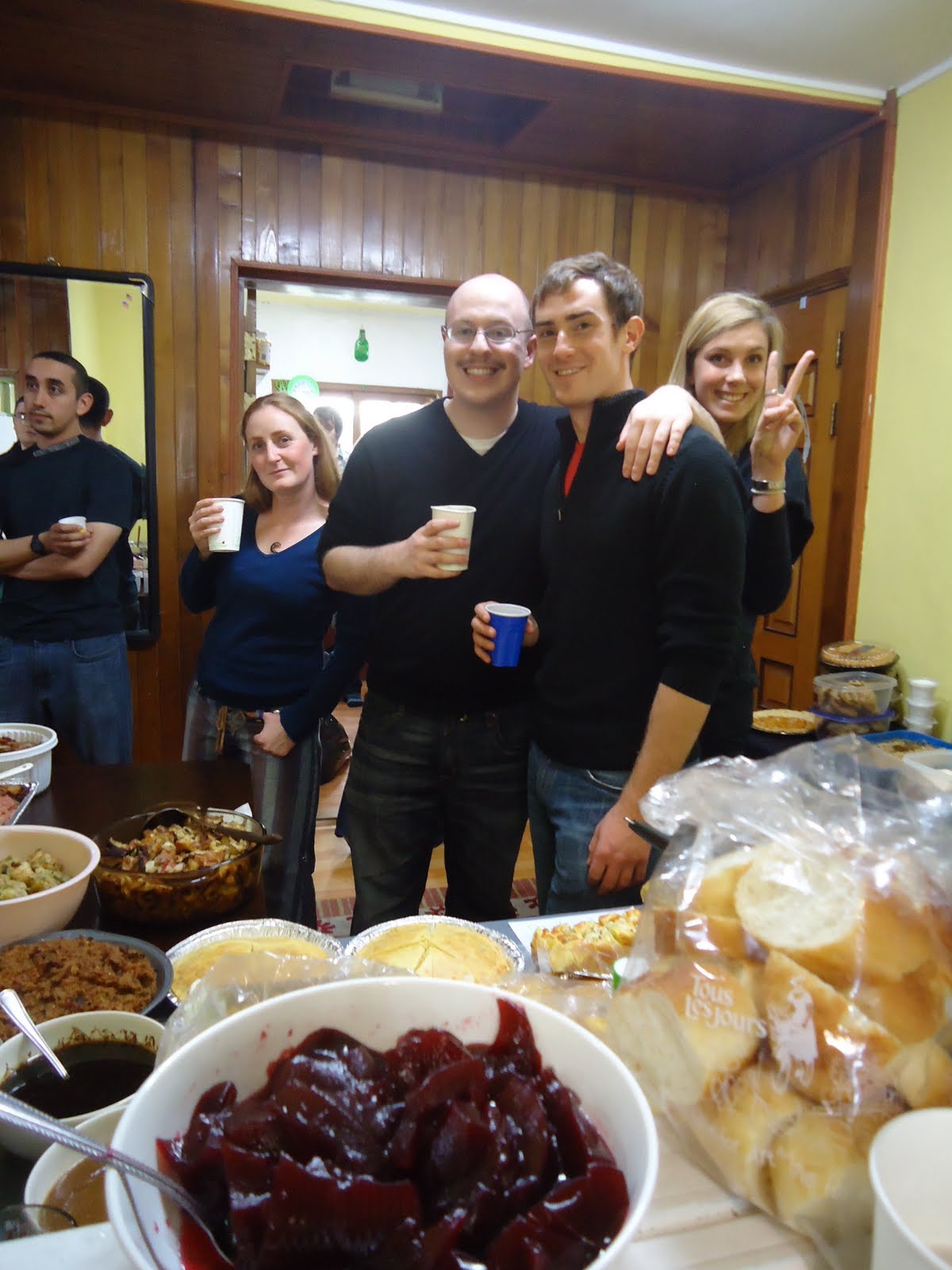
I also had just a few fresh chilies left from the garden, as well as some rare cornmeal, so I made a chili cheese cornbread. All this baking was early Saturday afternoon, after running 10 miles in preparation for a half-marathon next weekend. It was a busy day, but so satisfying to slip my warm dishes on the buffet table next to all the other amazing food and revel in the abundance while sipping a glass of wine. By the time every one trickled in with their food, there were at least 35 guests, and mounds of food from the traditional turkey, stuffing, mashed potatoes, candied sweet potatoes, and cranberry sauce, to spaghetti, green salad, and pasta salad, to Korean savory kimchi pancakes (김치전) and spicy clear noodles (잡채) to desserts of sweet potato pie, cheesecake, fruit crumbles, and cookies.

Other teachers, Air Force men, parents, and Korean friends filled this piano hagwon-turned apartment to the brim. The hosts had done an awesome job of setting up as much seating as possible in low, Korea-style tables. There was a ton of food, so much that you had to go back for seconds and thirds just to get a taste of everything!

Surprisingly, with all this food, it was a simple chocolate chip cookie that stole the show. Baked and brought by one of the Airmen, every person who tried this cookie freaked out. (Photo by Lindsay).

Afterwards, of course, we were all in food comas and needed to digest. One friend streamed the Thanksgiving Day Dallas Cowboys game, so it really felt like America. There was a side room with a heater on and pillows for laying down. I had to take a walk in the fading afternoon light. Upon return, once the game was over, we watched YouTube videos, played charades and had more pie and spiced cider.

So, under unlikely circumstances, the foreign community in Gunsan pulled off a pretty amazing holiday. It was a full day of food, friends, cute kids, work, and play. I am very thankful for all the wonderful people in this little city, and the willingness to put new spins on tradition.

Sunday, November 21, 2010

Babies, Buses, Big Cities


The weekend before last, I went to visit my friend who just had her first baby. She is from Colombia, and has been married to a Korean man for 9 years. They live in the neighboring city Jeonju, so I took a day trip to meet the cute little boy. Her mom is here visiting for the first time from South America, and I got to practice Spanish all day. It stretches my brain to talk about a 3rd language in my second language, saying things like "Quiero comer bibimbap" or "Yogi significa aqui". When I left her house that night, I was in Spanish mode and kept trying to speak to Koreans in Spanish.

I was in Jeonju waiting for a bus, and talking on my cell phone about meeting friends for a late dinner at my favorite noodle shop when I got back to Gunsan. I wanted to take the bus that went to Iksan, then Gunsan, which would say 익산, 군산 but I was distracted and got on the bus that said 익산, 논산. Now don't those look almost the same? I can read Korean but I made a mistake and was wishfully thinking that my bus was coming soon. Of course I didn't know there was a problem when we stopped in Iksan as usual, but later I realized I didn't recognize the next city AT ALL. Every one got off and the driver asked me where I was going, and when I said Gunsan, he shook his head. His next stop was Daejon, 2 hours from Gunsan! I jumped off the bus and went into the station, but by then it was 9pm and there were no more buses for Gunsan, Iksan, OR Jeonju. My stomach sank as I thought I might have to stay the night in this random town.

It is times like this when I find international living and not speaking the language most frustrating. I felt completely helpless in a strange place and couldn't talk to any one in detail about what to do. The ticket agent said "Daejon" and even though it would take me even farther from home, I thought perhaps I could catch a bus later from there since it was a big city. I bought the ticket and went back out to my driver. "Daejon?" he repeated. "No, Kicha, kicha!" he said, waving me away. I thought that he was recommending a closer city for me to go to, so I went back to the ticket lady to tell her "Kicha". She reluctantly gave me a refund, wrote something on a paper, and waved me toward the door saying, "taxi". The taxi took me to train station, and I realized that "kicha" meant train, and they often run later than buses. Luckily I caught a train back to Iksan, a taxi to the bus station, and a bus to Gunsan, with no harm done besides being tired and spending 3 times more time and money to get home.

Another girlfriend also recently had a baby boy, her second child here in Korea. She is British, and I give her major props for having kids in a foreign country. But I'm glad some one is, because I like having kids around in this community of friends. Besides the language barrier, there are many cultural differences in child bearing customs. For example, C-section rates in Korea are much higher than in the U.S. or England, with the majority of mothers opting for them even without medical necessity. Both of this friend's babies were over 9 pounds (probably unheard of in Korea), and both times the doctors recommended a Cesarean, and both times she had uncomplicated, natural births. When the babies are born they take them to the nursery, where they flash either a chili pepper or a peach light to announce if it's a boy or a girl. Why, I have no idea, but you can probably guess which one is for boy and which is for girl.

When I went to visit my friend the day after #2 was born, I was surprised to find her in a private, apartment-like room on a separate floor from the nursery. In Korea, the moms are kept separate from the newborns for the majority of the time, except when they go downstairs to feed. If they don't want to nurse they can pump breast milk or the nurses will bottle feed the baby for you. Also, it's customary for Korean moms to seriously rest for about a month after birth, staying warm and not lifting anything heavy. Moms are also supposed to eat 미역국 (miyuk gook), a seaweed soup every day for a week or two.

The clear broth is cleansing for the blood, the iodine helps the uterus shrink, and in general it is nutritious and considered good for producing milk. Then in turn, children are supposed to eat miyuk gook on their birthdays, to commemorate their mothers. Well, miyuk gook may be the ideal, but on Friday night my girlfriend and I opted for a pizza dinner instead after the kids went to bed. I got to bed early so I could wake up early for a 15 kilometer training run in prep for a half marathon in 2 weeks from now.


After the run, I headed to Daegu for my first time, which is the 3rd largest city in Korea after Seoul and Busan. On the map you can see Gunsan (Kunsan), Jeonju (Chonju), and Daegu (Taegu).

After the hour-ride to Jeonju, it's about 3 hours to get there- so a bit of a haul, but I wanted to see the city and a friend was already planning to go. And he lured me with promises of Mexican food and microbrews. Daegu is a big city, but it's pretty compact so it doesn't feel like you have to trudge through a bunch of sprawl to get somewhere. There is a subway, but it's only 2 lines making a t-shape. The main downtown is in one area, with many pedestrian streets linked together. Even though the street is closed to motor vehicles, people still drive cars and scooters through it in typical Korean style, but it is more peaceful than your average city street.

Along with the shopping, restaurants, bars, hofs, and clubs, there is also Western food! Now, I'm far from the kind of traveler who goes abroad only to eat American chain food, but I do like having a variety. I love Korean food, but I miss other foods and flavors. For dinner we went to a Canadian-owned restaurant/bar with an awesome menu. Mostly Mexican, with some different burgers and Greek food too. We shared a huge plate of nachos (!!!!!) as an appetizer, and I had a chicken gyro with lettuce, olives, and tzikiki and a delicious pale ale, a REAL microbrew from Canada. We left there stuffed, but managed to find room for a dessert cocktail from a street stand bar. I have never seen these in Korea, it's like a walk-up coffee stand, but for drinks, and you get a to-go pouch with straw. Brilliant.

We walked around, shopped, played foosball, and went dancing before calling it a night. On Sunday I had my first restaurant Sunday brunch in Korea, it's been over 8 months. I occasionally make a big brunch at home, but there is no cafe to eat Western food in Gunsan, and somehow I never have in Seoul. If you want to go out for brunch in Gunsan, you can choose from ramyeon, kimbap, udong, or fried rice. We went to a cheerful cafe where the clientele was about half Korean and half foreign. There was french toast, pancakes, and eggs on the menu, and I wanted it all. Luckily they had a 2 person set meal, so my friend and I shared a gigantic plate of classic pancakes, nut pancakes, brioche french toast, scrambled eggs, home fries, sauteed mushrooms, and coffee for 18,000 won or less than $9 each. It was heavenly. Afterward, we walked around and shopped for winter clothes like long underwear, arm warmers, down vests, and socks before wandering past medicinal herb shops.

We got to the bus station around 3, in perfect time to catch the 3:20 bus back to Jeonju. Only, the bus was sold out, and the next one wasn't until 5:40. We were really hoping to get back to Gunsan in time to have part of Sunday evening to relax. The train station was across the street, so, learning from my last bus fiasco, I thought we might as well check the train times. The station was packed, and after waiting in a long line, we found out that all the trains to Iksan and Jeonju were sold out. So we walked back to the bus station to get a ticket for the 5:40 bus... but by then, THAT one was sold out too! It was insane. I think there was some kind of festival or holiday I didn't know about, because I can't imagine why the transportation would be so full. We bought a ticket for the 7:40 bus which was the last one of the night to Jeonju.

With over 4 hours to wait in Daegu, we decided to go see "The Social Network" which just came out in theatres in Korea. Getting back on the subway, we trekked back downtown to a huge, 9-story Lotte. It was also packed there, with that hectic, impatient holiday-shopping feeling. We couldn't even get an elevator up to the cinema, because they were all full! Finally we took the escalator after navigating through a sea of shoppers. It was 4:13 and the movie had started at 4:10... and they wouldn't let us in! I guess they don't want late-comers disturbing people already watching the movie. Which is ridiculous, because Koreans talk, text, and answer their phones all through movies, so the peace is usually disturbed anyway! Obviously, today was not our day for good timing. By the time we got back to Jeonju at 10:30, it turned out the last regular bus of the night had left at 10:20, and there was just one last "midnight" bus at 11:40. Finally, I got home to my apartment in Gunsan around 1am, 10 hours after attempting to leave Daegu. So much for my relaxing Sunday night. That was not the most interesting story, but I guess it's just to say that some days are like that when traveling. Everything seems to go wrong, but ultimately it's your attitude that determines how much of a disaster it is. It can always be much, much worse.

Monday, November 15, 2010

Korean Summer Phenomena

It's way past summer now, but there are a couple Korea-specific things I meant to write about. Since linear time is over-rated, let's take a quick trip back to those sweltering hot months... a time when, in America, it's perfectly acceptable to sleep with a fan on and wear t-shirts.

First up is Fan Death. Here they believe that you should not sleep in room with the fan on if the windows are closed. The fan can chop up the oxygen molecules and you will suffocate, or the prolonged exposure to the fan wind can cause hypothermia, and you will DIE. I'm not joking. There are still cases every summer of people dying from "fan death"- doctors put it on death certificates, the government issues warnings, manufacturers can only sell fans with timers, and every smart, educated Korean I've asked about it says it is absolutely a real danger. This past summer at Mud Fest I stayed in guesthouse with many friends, and it was hot and some of us were sleeping with a fan on. One of the Korean friends, from a different room, came in around 8am and TURNED OFF our fan. He left and I immediately turned it back on. I thought it was rude, and strange, to come into a room you aren't staying and adjust some one else's cooling devices. My only "logical" explanation was that he was concerned about us dying from Fan Death.

The other thing is how much Koreans try to stay out of the sun. They consider lighter skin more beautiful, so they don't sunbathe or want to get tan, plus the sun is unhealthy and can damage skin and cause cancer. There's evidence that sunscreen isn't as healthy as it is marketed to be, often containing harmful chemicals and not lowering the rates of skin cancer. There is something to be said for staying in the shade or wearing hats and long-sleeves, but Koreans take it to an extreme. The summers here are hot AND humid, yet most Koreans wear pants, jackets, sun visors, face masks, gloves, boots, and umbrellas... ALL summer. It is astounding to me, who loves the feeling of a little sun on my skin, and who is already sweating in shorts and t-shirt, that they could be so bundled up. I think that Koreans have slowly evolved to not sweat in the heat. Seriously. This comic is by Luke Martin, from ROKetship on Facebook. It's perfect because it is SO true, this is what my whole summer was like.

Showing shoulders or upper chest is immodest, so I hardly wore tank tops last summer. On the few times my shoulders were exposed, older women would talk to me frantically in Korean, gesturing to my shoulders and then up to the sun, looking concerned. At the beach it's rare to see bikinis, or even other beachwear. Even in what I considered to be conservative summer clothes, I still got stared at a lot. That's one thing I appreciate about the cold here- now that it's 40 degrees colder, it makes sense to me to wear jackets and hats, and blend in a smidgen more.

Sunday, November 7, 2010

Love is in the Air

No, love is not in the air for me (sorry to get your hopes up Mom, haha). I went to my first Korean wedding this weekend! I met my friend Seongho (English name Saint) pretty early on when I came to Gunsan, and his English is good and he like to hang out with the foreigners. He got engaged to his girlfriend a couple months ago, and I was really happy and honored to be invited to their wedding. It was in his hometown of Sangju, a small city smack in the middle of the country, over 3 hours from Gunsan.

On Saturday morning I caught a ride with some other friends to arrive in time for the 1pm ceremony. Here weddings are earlier in the day than in the U.S. Outdoor weddings are very rare, instead they are mostly all in designated Wedding Halls or churches. This one was at a hall in a wedding hotel, which probably holds an average of 3 per Saturday, slating bookings one after another.

There are fresh flowers on easels like this, which you always see for major events, such as funerals, grand openings of a new business, and apparently weddings. Before the ceremony, the bride and groom were standing in the back of the room to greet guests. Saint was wearing a tuxedo and the bride was wearing traditional Korean hanbok. This is a colorful silk dress that consists of a short outer jacket and large skirt. It is customary to give money as a wedding gift, and there was a small, staffed gift table that has special envelopes ready. The older generation writes on the envelope in Chinese characters (hanja), as was customary for special occasions. No card is necessary, you just sign the envelope and give it to the helper man in exchange for your reception lunch ticket.

Then we all sat down, and here you can see the hall. It looked like a gaudy 1980's hotel conference room. There is an aisle with a bride and groom's side, and fake flowers. There were wedding hall staff who were young women in these hilarious outfits that looked like 1970's flight attendants, complete with the little cap. I really wish I had gotten a picture of one of them bustling around, seeing to last-minute details. It was past 1 o'clock and the chairs were only about half full, with many guest still standing and talking in the back of the room. I thought we would wait for them to sit, but then two older women started walking down the aisle. They were the mothers of the bride and groom, dressed in hanbok, and walked to the front to light a candle then sit on their respective sides.

After that Saint walked down the aisle. Meanwhile, there were 3 adorable little girls in white Western-style flower girl dresses, who had empty plastic baskets and sort of wandered around. Then Pachelbel's Canon started, and the bride walked down the aisle in a white dress with her father. She and Saint stood in front with their backs to the crowd while the officiant spoke.

To my surprise, the guests in back never sat down, and they continued to chat, answer their cell phones, and let the kids run around. This was probably the biggest difference from a wedding back home, where listening to the ceremony is very solemn and important. I asked a friend about it and she shrugged, saying the officiants all say the same stock speech, and it's nothing special worth listening to. The important part is physically being at the wedding, not focusing on what's said. The the couple is given a big saber-type sword, and they use it to cut the cake. The cake was 3 separate tiers, also at the front of the room, and together the couple makes one cut and that's it. What do they do with the cake, pristine except for one cut? After the man was done speaking, the couple stood in front of each respective set of parents, and bow to show their gratitude to the family. Finally they faced the audience and the groom shouted 만 세! (Mansay!) 3 times. This translates "victory!" or "hooray!", sealing the deal the way the kiss might in an American wedding. They receded down the aisle to claps and cheers and confetti and sprays of shaving cream... on the bride's perfect hair and dress. That surprised me too. Then they walked back down the aisle for pictures. First there are family portraits then one with friends.

Apparently at this time, it's normal for the couples to do a short, more private, traditional Korean ceremony. The bride puts back on her hanbok and only the immediate family is present. To my relief that's also supposedly where the cake gets eaten! All the other guests went downstairs for the reception lunch. Don't forget your ticket- it proves you were an invited guest who gave a gift, not some random off the street! No wedding crashing here, that's for sure. The buffet was one of the most huge and ecclectic I've ever seen- Korean food (rice, crab, duck, pork, clear noodles, tofu soup, marinated veggies), Japanese food (sushi, sashimi) and Western food (kernel corn, potato salad, green salad, crab salad). For dessert there were little cookies, rice cakes, and lots of fruit. For drinks you could have pop, beer, or soju. I met this little boy wearing hanbok who was all smiles. Eventually the bride and groom came down to mingle with guests, and the bride had changed yet again, into a modern black party dress.

Saint was kind enough to invite us to stay the night in Sangju, and spend the rest of the evening with him and his hometown friends. Usually after the reception lunch, all guests go home, but Saint and his wife weren't leaving for their honeymoon until midnight, so they would be hanging out anyway. He had gotten us all a room at the hotel, so we checked in to our rooms before going out again. We went to a nearby hof, which is a Korean cafe/sit-down bar, with the foreigners and about 8 of Saint's hometown friends.

We ate typical hof food like fried chicken, French fries, dried squid, fresh fruit, and nuts. We drank rice wine, beer, and soju. The drink of the night was 고 진 감 래 which is a shot of coca-cola under a shot of soju, dropped inside a large stein that is topped with beer. As you drink, you get a stronger soju flavor at first, then more beer, and finally at the end, the coke. The name comes from Chinese characters, and means "After struggle (or bitterness) there is sweetness". Here you can see one. I didn't try one, and was fighting a cold, but had a nice time meeting Saints friends and trying to communicate in our respectively broken English and Korean.

After the after-party, the party continued. We went to Noraebang! (Korean karaoke) We switched between English and Korean songs and the festive atmosphere continued. Eventually Saint and his lovely new wife had to leave for their honeymoon to Japan, and we had to get to bed. I don't know how typical my wedding experience was for Korea, but I'm very glad I got to see one during my time in this country, and share this special day with friends. I wish Saint and Sujin a long and happy marriage!

Tuesday, November 2, 2010

Embracing the Darkness

Over the last couple weeks, the sun has been a little lower every day after work. On Friday the sun had all but set, leaving thin bright pink clouds layered low on the dusky horizon. By the time I go running, it's completely dark, and very cold. We had about 3 weeks of decent fall temperatures before the current arctic chill came, and I'm still adjusting to it.

But I really love this time of year- the darkening, the crisp, smoky, decaying smells, the winter squash, apples, pears, little mandarins, and persimmons at roadside stalls, the sweaters and blankets pulled from their stacks in the closet. I want to drink tea and bake all the time. I also want to sleep more, but I'm fighting that hibernation urge and trying to keep on my regular gym schedule.

On Saturday, our school hosted an educational English Festival. We had info booths for the major English-speaking countries (USA, England, Canada, South Africa, and Australia/New Zealand) with maps, posters, activities, sports, crafts, and food from that particular country. I was doing the Australia/New Zealand booth, and we made about 450 mini ANZAC biscuits in addition to a "sausage sizzle". Our school also did a large trivia quiz for middle and elementary schoolers. Hundreds of people came, parents and teachers and students, and it ended up being really fun. It was sunny and warmer than usual as kids played cricket and threw boomerangs and made beaded bracelets and got their faces painted and learned about trick-or-treating...


...Because of course, it was Halloween! Koreans have a vague idea of Halloween, and you can see some costumes in the big box stores, but otherwise the holiday is not celebrated here. But us foreigners would not let that stop us- friends threw a Halloween party, complete with jack-o-lanterns, American candy, a costume competition, and spooky decorations. See, I LOVE costumes, and I was especially excited for Halloween this year since I didn't get to celebrate last year. Exactly one year ago I was doing 10 days of silent meditation in a Vipassana course. I wouldn't trade that experience for anything, but it was nice to not miss the holiday a second year.

I went as a panda, channeling my inner toddler in a full-bodied animal outfit with hood. One of the best costumes from the party: one guy was his Facebook profile, complete with a huge printout of the profile page and a box cut-out for his face where his picture would be. And my favorite was this guy who went as ddukbokki. It doesn't look like much if you haven't been to Korea, but for those of you who know this Korean dish of rice cake fingers and compressed fish cakes in chili sauce, you know that his costume is spot-on.

While I'm celebrating non-Korean holidays, I thought I might as well throw in another. I have been fascinated by the Day of the Dead in Mexico ever since my first Spanish class in 7th grade. I remember learning about Dead Bread (pan de los muertos) and the colorful flowers, pictures, food, and candles that are amassed on an altar in order to commemorate dead loved ones. It may seem a little dark, but it's actually the opposite. Instead of ignoring or eschewing death, this holiday recognizes and remembers loved ones who have passed on, and celebrates their life and the things they enjoyed. I have lost 2 very important people in the last year- a dear friend about a year ago, and my great-grandmother in August. I will never, ever forget them, and in fact, will keep their memory alive in many small ways. On Monday I tried my first attempt at the traditional bread, complete with an orange glaze and set it up with oranges, pears, and paper flowers.

And finally, one last celebration: two awesome friends of mine in the U.S. got married this weekend. Congrats Kimi and Justin! I really really wanted to be there for their wedding, but was not able to get the time off. I am so sorry to have missed what I'm sure was an amazing celebration of love, commitment, friendship, and joy. I wish them many happy years together.

Sunday, October 24, 2010

3 Year Anniversary

I have been blogging for 3 years! I started AmberAnda when I moved out of Bellingham in late October 2007. I think my first entry was about leaving the flower shop. Then I did a trip back east to Washington DC and South Carolina, flying there and driving a friend's new car back to Bellingham. Between my first time in our nation's capital, visiting a nudist community, driving thousands of miles cross-country by myself, and staying with BYU students in the heart of Mormon Utah, I had plenty of fodder for my first few blog entries.

Since then I have traveled throughout much of Latin America, sailed in Canada, lived in a yurt on an island, and moved to South Korea. In Spanish, I would translate Amber Anda "Amber on the Go" or "Amber Ambles", though for chunks of the last 3 years I have lived in one place. Whether traveling or staying put, experiencing the exciting or mundane, I have cherished this blog as a steady place to just write whatever I felt like. It's probably telling that I started it a few months after graduating college- with no more assigned papers, I missed having a reason to write in my life. Thank you for reading, whether you have stopped by once or are a regular follower. I appreciate having this means of communication.

Hey! While we're here, I might as well tell you about last Saturday. It centered around one of the most quintessentially Korean things possible- kimchi! This spicy fermented cabbage side dish is ubiquitous in Korean culture, and fall is the traditional time to make it, when the last of all the cabbage is harvested. The main vegetable of kimchi doesn't have to cabbage though- it can be radish, greens, or anything you want really. The vegetable is soaked in salt water, then coated with layers of chili paste, garlic, ginger, brined anchovies or shrimp, fish sauce, green onion, and other varying ingredients depending on preference and region. Since coming to Korea I have eaten it at least once a day, and truly love it. It is full of flavor and just feels... alive. Yesterday I went 2 hours south to Gwangju for the huge annual Kimchi Festival. You can sample chili pastes and powders, try different kinds of kimchi, fusion kimchi foods, watch live music and dance, go to kimchi exhibits, learn new kimchi recipes, meet contemporary Kimchi masters, buy a special kimchi fermenting pot or fridge, among many other things. Check out the mascots- huge napa cabbage next to a daikon radish.

Above is one of the many sampling booths that you had to elbow your way into if you actually wanted to try anything. I went with another teacher friend who I met at the Great Wall of China in July. She lives in Gwangju, and along with her friends, we made our own cabbage kimchi which we got to take home in nifty little pails.


Also, being foreigners, we got our pictures taken a lot by local press, and one friend got interviewed about kimchi. It was fun, and I'm hoping to make more of my own kimchi before fall is over. I actually planted a big bed of cabbage in my school garden, but it still has awhile to go before it will be full-sized. After having our fill of all things kimchi-related, we headed to downtown Gwangju for dinner. We went to an Indian/Nepalese restaurant which was INCREDIBLY exciting for me. I mean, I REALLY like a lot of Korean food, but the lack of variety after 7 months gets hard to deal with. Eating curry, chicken saag, and garlic naan was amazing. It was just nice to get out of Gunsan and see something different, and experience flavors Korean and foreign.

Wednesday, October 13, 2010

Gym Rat

About 2 months ago I joined a Korean gym. I had been running outside, but the summer was so humid that I wanted an indoor option. Sometimes I would run in the morning and it wouldn't be hot yet, yet in 10 minutes I would be sweating. I had never experienced sweating the the cool weather before. Korea has plenty of "fitness centers" around town, and for the most part they are pretty similar to a small American gym. Luckily this one is right in my neighborhood since convenience is key for consistent workouts.

Hey, have you ever seen these weighted hula hoops with the bumps? The bumps poke you and leave red marks, but apparently it's good for weight loss. I don't understand the science behind it but they are really popular here. Anyway, the gym has one main room with modern weight machines, free weights, treadmills, and stationery bicycles. It has locker rooms, sauna, and one classroom that is open during the day, and holds yoga and aerobics classes in the evenings.

I took yoga for about a month, but have decided this particular style is not for me. I enjoyed it for awhile- a good age mix of students, a tiny, burly instructor, and a good workout- even while not speaking Korean. But in addition to adjusting students' poses, the instructor would also push on us, and more than once I left class with my shoulders or knees hurting, and not in the good way. I would love to have a regular yoga practice here, but going to a class separate from the gym would be expensive and impractical, so I'll have to wait on that. I considered the aerobics class, but that's a different beast altogether- mostly 30 and 40-something women in outfits that look like a jazzercise/cheerleading/punk rock combo. The energy is high, the look is defined, the music is deafening, the pace is fast, and the room is already packed to the brim, so I've stayed away.

What I do really like about this gym is that it's incredibly chill. Every one is there to focus on their workout, and no one bats an eye at the foreign girl panting over by the chest press. I get stared at less at the gym than any other public place in Gunsan, so it's sort of like my safe haven. Two of my foreign guy friends in the neighborhood also go there, but I'm the only foreign woman.

Of course, there are some differences from a gym back home. You keep your workout shoes there, so they are indoor exercising shoes, not the same ones you would use outside. You don't wear shoes in the locker room-they provide slippers. The locker room etiquette is much more open, with loud talking while taking a long shower, or women standing in front of the mirror brushing their hair before bothering to get dressed. It's also common to see a bare leg propped up on a bench while a woman blow-dries her lady-region. It never, ever occurred to that that area would need any more than air-drying. From friends I've talked to, the men's locker room sounds pretty similar.

Workout clothes are different too. The gym provides shorts and a T-shirt for members, blue for the men, red for women. You can change into a clean set when you get there and put it in the hamper when you leave. There is only one size, which in the U.S. would never work, but here the one size really does fit all. It makes me feel a little bit like I'm in a middle-school P.E. class, but I actually like it. Less stinky clothes for me to take home and wash. Most members wear the uniform, but if they don't, they sport outfits like these ones: shirt, short skirt, flesh-colored tights, and leg warmers.

There is also an assortment of massage-type machines. This wooden one rolls around while you set your legs on it. It feels great on the calves. There is one where you stand and put a big belt around your torso and it vibrates, massaging where ever you move it to. And another one you stand on and it rock/vibrates you from side to side... I'm not sure what it does. There are a few large "inspirational" pictures of people working out, but they are all white people, which I find odd. Why don't they hang up pictures of fit Koreans?

The only other things of note are the funny signs or translations. The weight machines have instructions in English which are dubious, and the TV on the treadmill warns us against "watching too much monitor". And there is a garbage can in the women's locker room with a picture of two rabbits, the boy holding carrots and the girl holding flowers. It says, "It is a strange rabbit who prefers flowers to carrots." Anyway, I'm really enjoying the gym, going consistently, and it will be great to have the sauna when the weather gets even colder.

Sunday, October 10, 2010

Getting Out on Saturdays

I'm still really enjoying living in Korea, but after a rough patch including a bad haircut and loathing my city, I know it's time to be more proactive. I'm slowly accepting getting 6 months of hair growth chopped off into a Renaissance page-boy look, and also embracing hats as the temperature drops.

And as for Gunsan, it's more bearable as long as I can get out of town regularly on the weekends. Last Saturday a group of teachers went to Jeonju for the day, which is about 45 minutes away, and the capital of our province. It's still a small city, but much livelier and more cultured than Gunsan. We watched the last soccer game of the season, the drizzle and 0-0 score not dampening our spirits.

We went out for galbi, a type of Korean BBQ, in the university district, with plenty of side dishes and soju. It wasn't much different from a meal we might have in Gunsan, but it was just refreshing to be somewhere different, ya know?

Then we went to Art and Travel, a cafe-bar in the same neighborhood that has Western-style drinks, hookahs, travel photos on the wall, games to play, and hosts open mike nights. There is NOTHING like this in Gunsan. We played Scrabble while listening to poetry and live music, and Cherie and I even got up on the microphone to do an impromptu duet.

On Sunday I went to visit my friend Alex who is a new mama. Congrats to Kenton and Alex! They already have an ADORABLE one-year-old daughter, and just welcomed a son.


This past Saturday I went to Jirisan National Park. This is a place I've been wanting to go for months, as it has the tallest mountain in mainland Korea and many other peaks as well. I thought visibility might be better in the fall when it's not so hazy, and indeed it was better but not great. We still got a few vistas and the autumn foliage was beautiful.


I was with my 3 favorite hiking buddies, and we were making good time up the mountain. We stopped at Jangteomok Shelter for a lunch break. Instead of wraps or sandwiches that we might have hiking at home, as foreigners our fall back food is usually kimbab (seaweed/rice rolls). That plus "trail" food like nuts, granola bars, apples, and crackers. But Koreans always bring a stove and are eating hot ramyeon and kimchi side dishes.

After the shelter, the trail was really crowded. Maneuvering the foot traffic, we finally made it to the peak, along with masses of other people. We snapped a quick picture before descending down another trail. We thought it would take us about the same amount of time to go down as up, 3.5 hours. We had gotten a decently early start, and would have no trouble getting down by dark, and possibly in time to catch buses back to Gunsan.

But the trail was really hard to navigate. I have never seen switch-backs in Korea; they just build the trails straight up the mountain. Then to avoid erosion (I'm guessing) they line the trail with large, uneven stones. What it creates is a steep, inconsistent, and slippery path. It's really quite trecherous in parts. We were taking it pretty slow. Then one of my friends slipped on a janky staircase and slid down, dislocating both shoulders. It was a very frightening moment, though it definitely could have been worse. So after that we took it even more slowly. Soon after, a helicopter flew overhead, sending leaves and residual water pelting down on us. In the distance, we could see it lower a man down to do a medical evacuation.

Then, less than an hour later, some rangers passed us, leading a man carefully by the elbow. He was walking stiffly with a foam sleeping pad wrapped around his torso like a brace. Another helicopter flew over us, and the rangers stopped us on the trail. We couldn't pass until they evacuated this man, so we waited in the incredibly strong double-blade chopper wind and roar. Clearly, this was a fairly dangerous trail. We continued cautiously, watching each step. Eventually it started getting dark, and the last 1.4 kilometers were in the dark with headlamps and flashlights.

We knew that the exit trailhead had restaurants and hotels, so we weren't worried about that. It was just a matter of pushing through tiredness, and not losing patience on a trail where you wanted to move much faster but simply couldn't. When we finally reached paved road, it had never felt so good to just walk, full strides, without watching our feet. We got a room and a hot dinner and all crashed out early, exhausted. We agreed that we weren't sure if we conquered the mountain or it conquered us, but it was definitely an epic day that none of us would forget.